
NemoClaw Is Built on 50-Year-Old Engineering. That's Exactly the Point.



There is a battle playing out at the center of the agent world right now. On one side: Anthropic and OpenAI, two companies that spent most of 2025 learning a bitter lesson. Shipping fast does not mean organizations actually adopt. On the other side: Nvidia, which just launched NemoClaw. Embedded inside that launch is a philosophy that is quietly more interesting than the product itself. NemoClaw is built on engineering principles that are fifty years old. And that is not a criticism. That is the point.
The Lesson Anthropic and OpenAI Learned the Hard Way
Both companies shipped at extraordinary velocity through 2025. Anthropic pushes updates roughly every eight hours. OpenAI is not far behind. But when they examined what was actually happening inside enterprise engineering teams, they found something uncomfortable: the speed of shipping and the speed of adoption were completely decoupled. Teams could not get the tools working in actual production environments. Not because the tools were bad. Because organizations lacked the foundational engineering hygiene to absorb them. The gap was not capability. It was context.
The response has been predictable: both companies are now partnering with large consulting firms to bridge the adoption gap. Which means they are outsourcing the narrative of how their own technology gets deployed. That is a significant thing to give up. In an environment already full of noise about what AI can and cannot do, losing control of that narrative carries real risk.
Jensen's Different Bet
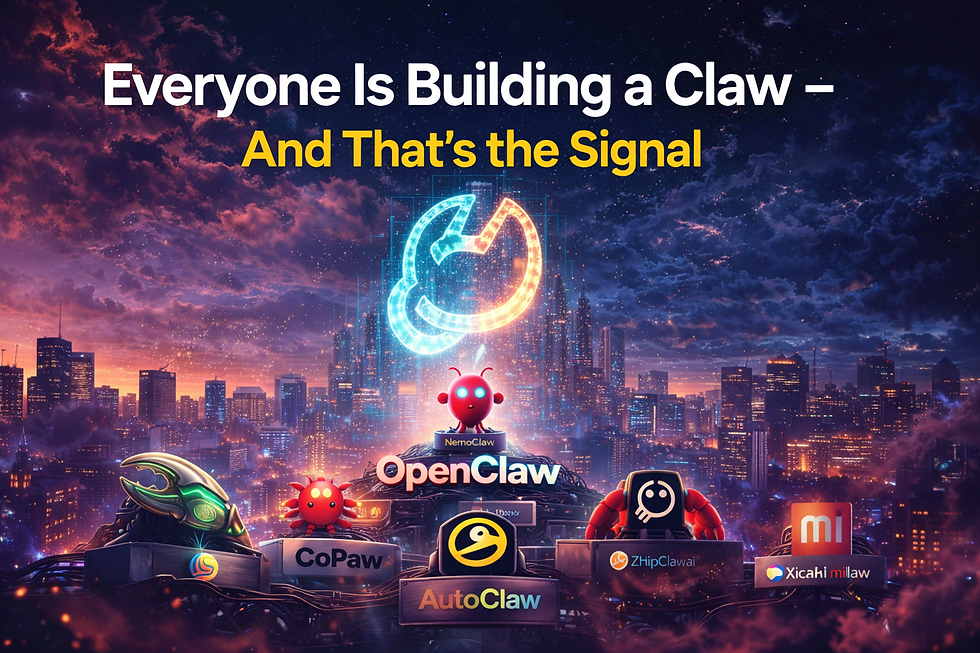
Nvidia's response to the same problem is structurally different. NemoClaw is an add-on layer over OpenClaw, not a replacement. It runs inside OpenShell, Nvidia's proprietary runtime, wrapping the open agent instance in policy-based guardrails defined as YAML declarations. Model constraints. Local-first compute. Enterprise-grade security. Locked down in ways that raw OpenClaw cannot be. But the more interesting thing Jensen communicated at launch was not about the security layer. It was the posture behind it. He looked at the developer community and said: you can figure this out. You have good engineering instincts. Here are primitives that respect those instincts instead of abstractions that obscure them. That is a very different message than the one Anthropic and OpenAI have been sending, which has often landed as: this is complicated, trust us, let us handle it.
Rob Pike's Five Rules Still Apply
To understand why NemoClaw's philosophy resonates, you have to go back to Rob Pike, co-creator of Unix and Go, and his five rules of programming. These are not obscure. They get taught in computer science programs. Senior engineers pass them to juniors. They are foundational.
Rule one: you cannot tell where a program will spend its time. Bottlenecks appear in surprising places. Do not optimize until you have proven where the bottleneck actually is. This is as true for agentic systems in 2026 as it was for handwritten code in 1976.
Rule two: measure before you tune. If you are not baselining performance, you are guessing. Guessing about autonomous agents that have access to your systems is a particularly expensive habit.
Rule three: simple scales. Fancy algorithms are slow when your number is small, and your number is usually small. Overbuilt orchestration pipelines fail in production not because they are not clever, but because they are too clever for the actual scale of the problem.
Rule four: fancier algorithms are buggier. The more complex your agentic system, the harder it is to debug. Is it the prompt? The context? The tool call? The model? Simplicity is not a limitation. It is a debugging strategy.
Rule five: data dominates. Choose the right data structures and the algorithms become self-evident. Write dumb code. Have smart objects. This is the rule that matters most in the age of AI, and the one most consistently ignored by people selling AI transformation.
NemoClaw's architecture is essentially these five rules applied to enterprise agent deployment. Nvidia engineers work close to the kernel. They optimize for GPUs. That kind of work demands discipline and punishes shortcuts. The culture it produces understands these principles at a level most AI-adjacent engineering teams do not.
The Five Hard Problems in Production
There are five concrete problems that consistently appear when organizations run agents in production. They are regularly sold as new AI challenges. Every one of them has roots in engineering practices that are decades old.
Context compression. Long-running sessions fill context windows. The best approach maintains a structured, persistent summary with explicit sections for session intent, file modifications, decisions made, and next steps, updating incrementally rather than regenerating from scratch each time. The principle underneath: preserve structure. That is not new. That is data hygiene.
Codebase instrumentation. This is not an agent problem. It is a software hygiene problem. If you cannot measure your current baseline, latency, response quality, a golden test dataset you can validate against, you cannot optimize. Pike's second rule, applied to 2026.
Linting discipline. Strict linting rules that enforce clean, simple, consistent code structure are one of the highest-leverage interventions available. Agents are lazy developers trying to get the job done and move on. A strict linter is the constraint that keeps the codebase from drifting into compounding complexity.
Multi-agent coordination. The pattern converging across the industry is deliberately simple: planners and executors. A planning agent decomposes work. Executor agents carry it out. It maps cleanly to how we have always thought about separating concerns in software systems. Do not optimize it prematurely.
Specification discipline. The hardest problem and the most underappreciated. Teams consistently struggle to define what they want clearly enough for an agent to act on reliably. That is not an AI problem.
That is a thinking problem. Precise specifications, clean context hierarchies, resistance to stuffing everything into the context window and hoping. These skills have always mattered. Agents just make the cost of skipping them much higher.
What NemoClaw Actually Signals
NemoClaw as a product is interesting. NemoClaw as a strategic play for Nvidia, moving from chip revenue toward ecosystem and value chain, is very interesting. NemoClaw as a signal about what good agentic engineering philosophy looks like is the most interesting thing of all.
It says: you are capable. The fundamentals you already know apply here.
Build on what works instead of mystifying what is new.
That message is not coming from the AI labs. It is coming from a chip company. And maybe that tells us something about where the clearest thinking in this space is actually happening right now. The engineers who have spent decades optimizing for the metal have little patience for complexity that does not earn its keep. That instinct is exactly what the current moment needs. Rob Pike's rules are not out of style. They never were.


Comments