
The Claw Rosetta Stone — Power, Risk, and the Part Nobody Has Built (Yet)


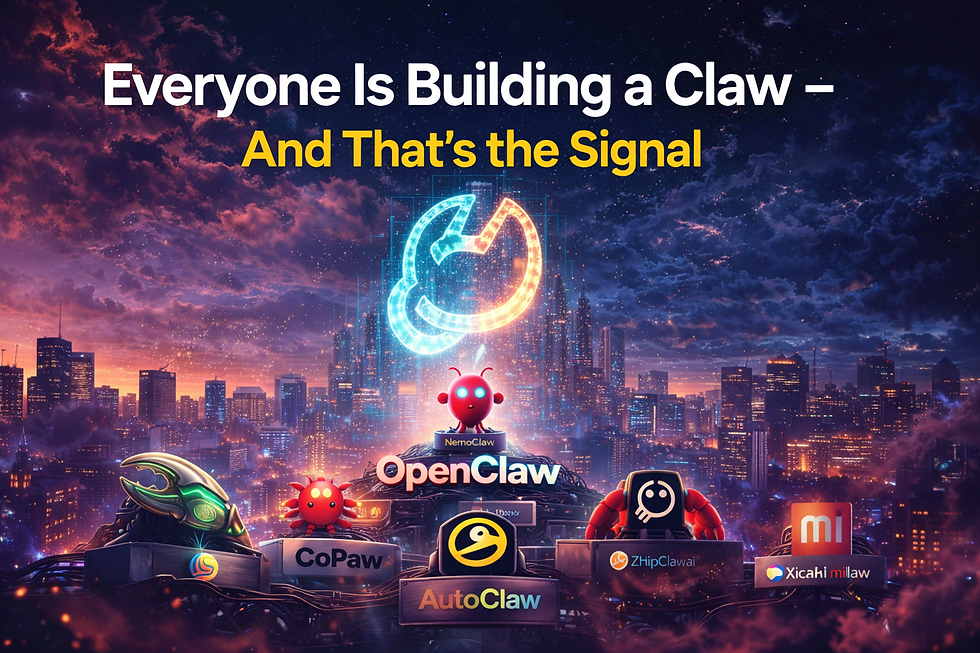
There’s a moment in every technology cycle where the signal is real…but the behavior around it gets reckless. We’re in that moment. Everyone is building a Claw. Everyone is selling a Claw. And a growing number of people are installing Claws into environments they don’t understand, with access they can’t see, doing things they didn’t fully intend. That’s the part we need to talk about.
The Map Is Real — But It’s Not Safe by Default
Yes, there’s a structure to this ecosystem. Yes, every company is making a strategic bet. Yes, this is absolutely where things are going. But let’s add the missing truth: These systems are powerful, experimental, and inherently unstable without constraints. And right now? Most people are running them wide open.
The Three Axes — Now With Real-World Consequences
We’ve got the map:
where it runs
how it thinks
how you interact
Now layer in reality: These aren’t technical choices. They’re risk decisions.
Because when you plug a Claw into your:
email
calendar
CRM
internal systems
You’re not testing AI anymore. You’re delegating operational authority.
What I’m Seeing in the Wild
Let’s not sugarcoat it.
A huge percentage of people right now:
don’t understand open-source risk
don’t understand plugin exposure
don’t understand how credentials propagate
And they’re installing systems anyway. Sometimes for free. Sometimes for cheap. Which usually means: You’re not the customer. You’re part of someone else’s architecture. That’s not paranoia. That’s how these systems are wired.
The “Magic Wand” Problem
Here’s something I didn’t expect—but I’ve now seen repeatedly. You hand someone one of these systems…and they freeze. They look at you like:
Okay… what do I actually do with this?
Because the honest answer is: Anything. And that’s the problem.
Unlimited capability without structure doesn’t create leverage. It creates hesitation—or chaos.
Why I Don’t Deploy These Wide Open
This is where my approach is different.
Every client environment I build is:
isolated (no cross-client bleed)
hybrid (controlled infrastructure + cloud resilience)
contained inside a cognitive architecture layer
That layer matters. Because structure is what determines behavior
Not prompts. Not features. Structure.
What That Actually Looks Like
The core intelligence layer runs on controlled infrastructure
Cloud is used for uptime, scale, and execution elasticity
Each client operates inside their own bounded environment
No uncontrolled spawning, no blind system-wide access
It’s not about limiting capability. It’s about governing capability.
Why Clients Don’t Get “Full Power”
Not because they couldn’t. Because they shouldn’t. Yet. This isn’t enterprise-stable technology. And more importantly: most people don’t know how to think with it yet
That’s not a knock—that’s reality. So instead of handing someone raw autonomy, the approach is: guided capability with guardrails
Training wheels—not as a limitation, but as a transition. Because once you’ve seen what happens without them…You don’t skip that step.
What It Looks Like When It’s Done Right
Inside a governed system, this becomes:
social media that runs like a machine
CRM that stays aligned automatically
email and calendar that self-orchestrate
operational flow that actually reduces cognitive load
Not chaos. Coordinated execution. And that’s where the leverage shows up.
The Part Most People Haven’t Realized Yet
This Claw moment didn’t start the real shift. It exposed it. Because underneath all of this is a deeper transition: From: tools you use To: systems that act on your behalf
And once you cross that line…The question changes.
The Missing Layer (And Where This Is Actually Going)
Right now, the entire ecosystem is focused on:
capability
orchestration
execution
But it’s missing the layer that actually matters long-term: aligned responsibility Or more precisely: Fiduciary Intelligence
Not just systems that can act.
But systems that are:
structurally aligned with your interests
context-aware over time
capable of judgment—not just execution
The difference between: a tool and something you trust to operate for you
Quiet Truth
Most of the market is building: execution engines Very few are building: trust architectures And those are not the same thing.
Where This Is Headed
Everyone is building their Iron Man suit. That part is settled. But the part nobody has fully built yet? What sits inside the suit—and whether you can trust it
Final Thought
This technology is real. It’s powerful. It’s transformative. And yes—everyone should be learning it. But right now? We have: capability without responsibility And that gap is where most of the risk lives. I’m not telling you to stay away. I’m telling you to be intentional. Because this isn’t just software anymore. This is: delegated intelligence

And the moment you delegate…You’ve already made the most important decision: who—or what—acts in your best interest when you’re not looking
That part? Still isn’t solved. But it’s being built. Carefully.
#AI #AgenticAI #OpenClaw #FiduciaryIntelligence #AIAutomation #FutureOfWork #AIInfrastructure #AutonomousSystems #AISafety #DigitalTransformation


Comments