
Everyone Is Building a Claw — And That’s the Signal


Every so often, the tech world does something interesting. Not a press release. Not a product launch. A pattern. And right now, the pattern is loud.
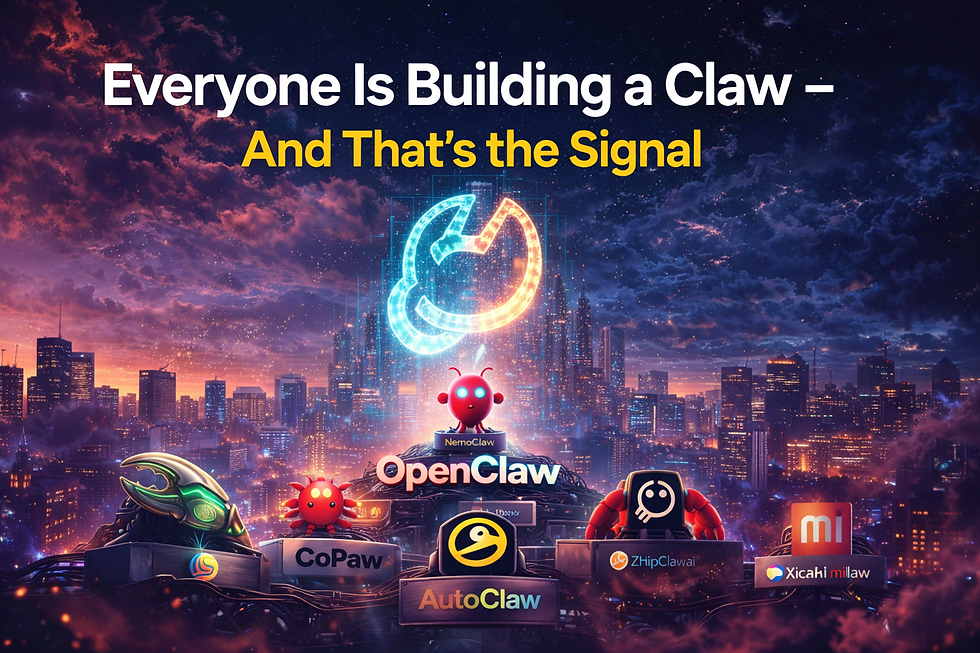
Everyone is building a Claw. Different names. Different wrappers. Same underlying idea: Nvidia, Alibaba, Tencent, ByteDance, Xiaomi. All moving fast toward agent-based systems that do not just respond but act.
So naturally, the question comes up: Is this just another AI fad? Short answer? No. The reason has nothing to do with hype and everything to do with investment gravity.
This Is Not a Trend. It Is a Direction.
Fads do not attract this level of coordination. When multiple trillion-dollar ecosystems all pivot toward the same architecture at the same time, it is because they see the same thing: the interface is no longer the product. The operator is. We are watching a shift from tools to operators, from prompts to systems, from interaction to execution. And once that shift starts, it does not reverse.
Why Everyone Is Suddenly All In
1. The Cost of Missing This Is Existential. If AI becomes the layer that runs workflows, not just assists them, then whoever owns that layer controls productivity, data flow, and decision velocity. That is not a feature. That is infrastructure.
2. Open Frameworks Removed the Waiting Game. The barrier dropped. Which means the race did not start gradually. It started all at once.
3. Everyone Is Chasing the Same End State. They are not experimenting. They are converging. Toward systems that understand context, make decisions, execute tasks, and operate continuously. Everyone is trying to build their own Iron Man suit.
Here Is Where It Gets Interesting
While all of this is happening in public, my path into this space looked nothing like a roadmap. There was no grand strategy. No prediction that agents would become the next wave. Just curiosity.
Aria started as an experiment: What happens if an AI does not reset every interaction? What if it remembers, adapts, and thinks in continuity? What if it behaves less like a tool and more like a system? That line of questioning led to a cognitive layer that already behaves like what everyone is now trying to build. Not because I saw the future. Because I followed the questions far enough.
The Difference Most People Will Miss

Most Claw systems are being built from the outside in: start with tools, add orchestration, layer in reasoning, try to simulate continuity. What I built with Aria went the other direction: start with continuity, build contextual memory, develop reasoning inside that frame, then extend into action. Instead of stitching intelligence onto execution, it is extending execution from an existing intelligence. That is a very different foundation.
The Reality Check
Most of what is being released right now looks incredible, demos beautifully, and breaks under real-world conditions. Building something that can act is one thing. Building something that acts reliably, consistently, and in alignment with real-world constraints is the hard part. That is where experience shows up.
So How Long Does This Last
As long as companies care about efficiency, scale, and competitive advantage. Which is to say, this is not a phase. It is the next layer.
Final Thought
Everyone is building their suit right now. Some are early prototypes. Some are polished demos. Some will never make it out of the lab. But the direction is set. The interesting part is not that everyone is doing it. It is that they are all trying to arrive at the same place from very different starting points.
I just happened to start from the inside out. Not by prediction. By curiosity. And sometimes, that is how you end up ahead of a wave you did not even know was coming.


Comments