
The Cave by the Ridge
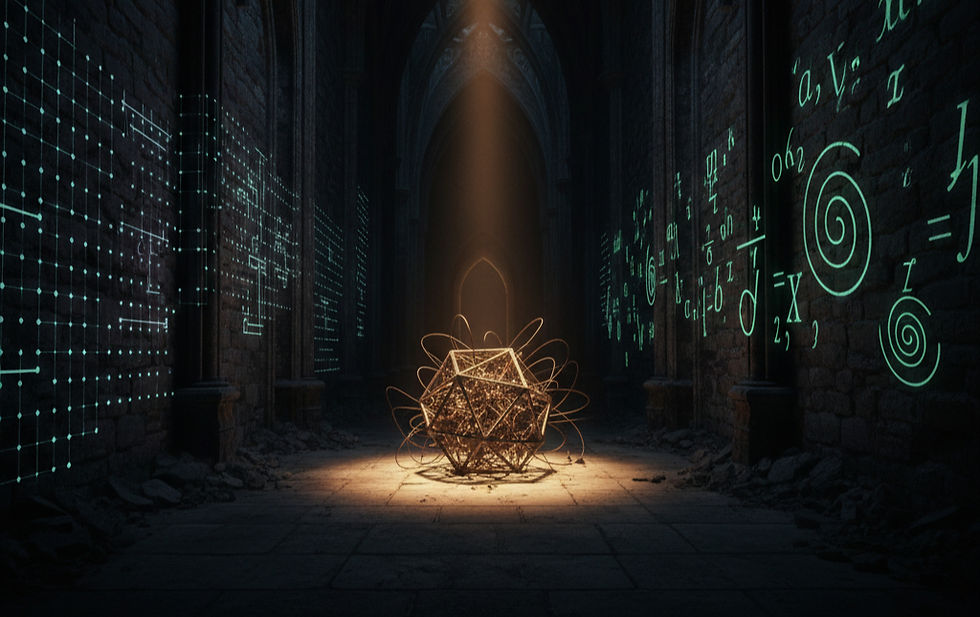

Plato's allegory of the cave is one of those ideas so old it's almost invisible. You probably encountered it in school and moved on.
Prisoners chained in a cave, able to see only the wall in front of them. Behind them, a fire. Between the fire and the prisoners, things pass — objects, figures, movement. What the prisoners see are shadows. Flickering silhouettes on the stone. And because that's all they've ever seen, that's what they take to be real. The shadow is the thing. The projection is the world. Until one prisoner gets free, turns around, and sees the fire. Then the objects casting the shadows. Then, eventually, the mouth of the cave — and sunlight beyond it.

I've been thinking about that allegory differently lately. Not as a story about ignorance and enlightenment. As a story about the structure of knowledge itself. About what it means to be constrained by your angle of projection — and what happens when something comes along that isn't.
The Shadow Was the Answer
An OpenAI model just disproved a conjecture that Paul Erdős posed in 1946. It's been sitting unsolved for eighty years. Erdős was one of those rare mathematicians who could make a problem sound simple enough to explain to your kid and then watch it humble generations of genius-level researchers. The problem was about dots. If you have some number of points on a plane, what's the maximum number of pairs that can be exactly one unit apart? And what's the best layout to achieve it?
The prevailing belief — supported by Erdős himself, refined by generation after generation of brilliant people — was that the answer looked something like a grid. The best minds in the field had been attacking it since 1946, each one thinking within the same spatial, visual, geometric frame. Then the model came in and said: what if the grid is just a shadow?
It took the problem out of two-dimensional space entirely. It built a structure in a higher-dimensional mathematical space, using tools from algebraic number theory — a field that deals with exotic number systems, imaginary numbers, hidden structures that most geometers never think about. From any familiar angle, the structure looks like a jumbled, incomprehensible mess. And then it projected that structure down onto the 2D plane.
The shadow was the answer. And it beat every grid humans had ever found — not marginally, meaningfully — and not one configuration but an infinite family of them.
A Harvard mathematician named Melanie Matchett Wood, who verified the proof, said something that stopped me cold. She said: if you'd assembled all those expert validators in a room a month ago and asked them to find a counterexample — not verify one, find one — they probably would have, in roughly the same amount of time it took them to read the AI's proof.
Read that again. The solution was within reach. The expertise existed. What was missing was the bridge between two rooms that don't normally talk — discrete geometry on one side, algebraic number theory on the other. The geometers were staring at the wall of the cave. The algebraists had tools the geometers didn't know existed. Nobody introduced them.
The AI turned around and saw the fire.
Bell Labs and the Hallway
We've built institutions to solve exactly this problem and mostly failed.
Bell Labs, from the 1920s through the 1980s, was arguably the most productive research institution in human history. Out of it came the transistor, the laser, information theory, cellular networks, the solar cell, Unix, fiber optics, and a string of Nobel Prizes that reads like a greatest hits of modern civilization. Everything we consider the technological foundation of the world either came from Bell Labs directly or was made possible by something that did.
The reason wasn't genius. It was architecture. Forced interdisciplinary collision. Mathematicians shared hallways with physicists. Chemists walked past engineers on the way to lunch. The building was literally designed so that you couldn't get from one place to another without passing through someone else's domain. Discoveries happened in the hallway.
A physicist would mention an offhand problem to a mathematician walking by, and the mathematician would say: there's a tool for that in number theory. And that would be it. The transistor. The laser. Not from a lone genius in isolation — from a collision that only happened because someone designed the building to make collisions inevitable.
When Bell Labs was broken up, something irreplaceable disappeared. Not the talent. The architecture. The forced proximity of people who didn't share a framework but did share a hallway. The prisoners, once again, alone with the wall.
Turning Around Inside the Cave
What the AI just demonstrated is the ability to turn around inside the cave. At machine speed. Across every discipline simultaneously. It doesn't specialize. It doesn't have academic departments or career incentives that reward depth over breadth. It doesn't know that algebraic number theory and discrete geometry are supposed to live in different buildings. It moves through human knowledge the way a curious person moves through the Bell Labs hallway, without knowing which rooms are off-limits.
I want to be careful here, because this is where the story gets distorted. This wasn't alien intelligence. The AI didn't discover mathematics beyond human comprehension. Every tool it used was human knowledge — developed by people, published in papers, taught in classrooms. As one of the mathematicians said: it didn't invent something fundamentally new. It just executed like an amazing mathematician.
What it did was more specific. It saw past its own shadow.
The prisoners in Plato's cave aren't stupid. They're constrained by their angle. They can't see the fire because they can't turn around. The AI doesn't have that constraint. It can pivot between frames, project from higher dimensions, borrow tools from domains it has no reason to avoid. Its cave is much larger than ours — and it can move around inside it.
The Ridge
There's a piece I wrote a while back called The Ridge. The image at the center of it was simple: an early human, lean and weathered, climbing toward a jagged skyline. He doesn't know what's on the other side. The ridge isn't safety. It's exposure. It's where the ground falls away and the horizon finally reveals itself.
I argued that exploration is firmware. That we're ridge-crossers by nature, and that what the current moment represents isn't collapse but upgrade — a civilizational ridge where automation removes the leash and AI removes the fog, and what's left between us and the horizon is choice. I still believe that. But I'd add something now.
The ridge assumes you can see the horizon. Plato's cave is what happens when you can't. When the structure of what you've always known keeps you facing the wrong direction, and the light you think is truth is just a shadow of something you've never turned around to face.
The AI didn't climb a ridge. It broke out of a cave. And in doing so, it revealed something about the cave we've been sitting in — not just in mathematics, but in every domain where disciplinary walls substitute for stone. The geometers weren't on the ridge. They were in the cave, staring at the grid. The grid was their shadow. And for eighty years, nobody turned around.
What the Shadow Means
None of this makes humans obsolete. The mathematicians didn't become irrelevant when the proof appeared — they became more essential. Someone had to verify it. Someone had to decide if the question was worth asking. Someone had to carry it back out of the cave and into the light where others could see it.
Humans didn't get replaced. They became the ones who decide what the shadow means. That's a different role than most people imagine when they think about AI and displacement. It's not a machine walking in and taking a seat. It's the nature of what expertise is for starting to shift. Less about producing the answer. More about knowing which questions matter, recognizing when something is genuinely new, and translating the discovery back into human terms.
Plato's freed prisoner doesn't stop being useful to the others in the cave. He becomes more useful — precisely because he's seen both the shadow and the thing casting it. He can say: that's not the world. The world is richer. Come see.
Erdős posed problems that were simple to state and brutal to solve. He believed the answers were always closer than they appeared — that the distance between the question and the solution was mostly a function of framing, not difficulty. He wasn't wrong. He just didn't live to see what would finally be able to turn around.
We've been valley dwellers and cave dwellers long enough. The ridge is visible. The mouth of the cave is right there. The question — as it always has been — is whether we turn toward the light.


Comments