
Networked Paper

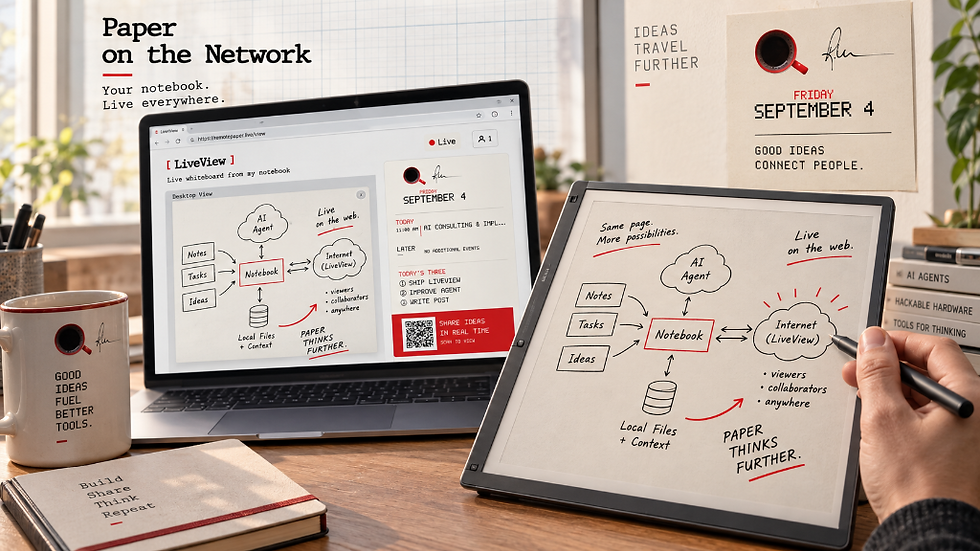
This one kind of happened by accident. Not in the sense that I tripped over a soldering iron and somehow built a product, but more in the way a lot of the things I enjoy messing with tend to happen. You start with one small thing, ask one unnecessary question, then another, and at some point realize the original thing you were trying to do was just the excuse that got you through the door.
The reMarkable was a gift from Rolf, which makes this whole thing funnier in retrospect. He's the same Rolf from The Light Bulb Moment, where we were talking about AI and I watched the whole idea of intent and execution suddenly click for him. He gave me this thing sometime after that, and I liked it right away, mostly because it doesn't behave like every other device in my life.
It feels like paper.
That sounds obvious, because that is literally the point of a reMarkable, but there's a difference between something being marketed as paper-like and your brain actually accepting it that way. The iPad never did that for me. I have an Apple Pencil. I have probably used it two or three times in my life, mostly to edit a photo. Drawing, writing, thinking with it never became natural. It always felt like I was using a computer that happened to have a pen attached to it.
The reMarkable is different enough that I stopped noticing the device pretty quickly. Then, naturally, I turned on Developer Mode.
Once you know there is a little Linux machine living under there, the question becomes unavoidable.
What else can this thing do?
That question has probably cost me more weekends than almost anything else in my life.
The first answer wasn't particularly dramatic. I changed the sleep screen. Put my coffee cup on it, my signature, a QR code, some identifying information. Mostly just made it feel like mine.
Then I started looking at all that dead real estate and thinking it was kind of ridiculous that this beautiful low-power display spent most of the day telling me that the device was asleep.
So the static screen became a little daily board. Calendar. What's next.
A few priorities. Tomorrow. Nothing crazy. Just enough that when the thing was sitting on the desk, it was actually telling me something useful.
That connected almost immediately to something I had already been thinking about for a while.

I built a little device called Porthole. It was basically another one of these "what else can this thing do?" projects, except with a small ESP32 display. The important part of that project wasn't the hardware. It was the realization that a little physical screen could become a portal into whatever intelligence or context mattered at the moment.
The thinking lived somewhere else. The screen was just where some of it showed up.
That idea has been following me around for a while now because I keep finding myself trying to remove interfaces. I wrote about that too. Not removing screens literally, but trying to collapse the distance between what I want to do and the machinery required to do it.
Sometimes I make things dramatically more complicated in the process, which is objectively funny. I will absolutely build six pieces of infrastructure to eliminate one annoying click if the problem interests me enough. Usually that's fine because a lot of the payoff is the learning.
This time, though, something lined up in a way I wasn't expecting. The reMarkable didn't just become interesting because I could put information onto it. It became interesting because I could write back. That was the part Porthole didn't have. The surface was no longer just a little portal from the digital world into the physical one. It could go both ways.
And that's when the whole paper thing started getting much more interesting.
I have had a live desktop page on my website for years. It's one of those little utilities I built because I hate explaining where to click during a call. I can start a share on my laptop, tell somebody to go to my site, and they can see what I'm doing.
That's how I like these things to feel. Seamless. No strange platform hop. No account creation. No "now go over here and log into this other thing."
Just go to the page. There it is.
reMarkable already has screen sharing built in, and it's actually pretty slick. The problem wasn't that they had failed to solve screen sharing. The problem was that their version quite reasonably lives inside their ecosystem, and I didn't want that boundary. It's my notebook. It's my website.
If I'm sharing the notebook, I want it to feel like the notebook simply exists there.
That became the next rabbit hole.
There were a few false starts. A few moments where it looked like the thing might happily behave like a conventional streaming endpoint, followed by the reminder that no, this is still a weird little e-paper Linux device and not a miniature production workstation. Eventually, though, I got it working in the way I wanted.
Now I can have my desktop on one side of the page and the reMarkable on the other. And that sounds like a very small thing until you actually use it.
I found that out the next morning.
I had woken up and realized the "public" side of the thing wasn't actually public outside my VPN and local network, which was mildly inconvenient given the whole idea. That was a small fix.
Then I had an 11 o'clock meeting.
We were talking about the architecture for a bot system for a small team, and normally I would have explained the whole thing verbally. I can do that. I have been explaining technical systems for most of my life.
But explanations like that get expensive pretty quickly.
You introduce a term, then you explain the term. Then you explain how one component talks to another. Then someone asks a question about a part you thought you had already covered, and eventually everyone has a slightly different diagram in their head.
So I picked up the Marker and said, basically, "Okay, here's what I mean."
And I drew it.
A box. Another box. An arrow. This talks to this. These people interact here. This thing sits in the middle.
Someone asked a question, so I circled the part they were talking about and added another line.
That was it. They got it.
And what hit me was how completely normal it felt. I hadn't really done that in years. Maybe twenty.
There was a time when that was just how I communicated. If I was sitting with somebody and the explanation started getting messy, I would grab a piece of paper out of the printer and sketch it.
Network.
Software.
Data flow.
Circuit.
Whatever.
It was just easier. Then paper slowly disappeared from my life. I don't even own a printer anymore. I think I got rid of printers around the same time I got rid of a landline and cable TV. It just never came back. And somehow, I never replaced that particular behavior.
I had all the digital replacements. Styluses. Tablets. Whiteboard apps. The Apple Pencil.
None of them ever became the thing.
This did.
It took maybe a minute for the old motion to come back, and then it was like riding a bike. Muscle memory.
Box.
Arrow.
Circle.
Underline.
Cross something out.
Draw another path.
Keep talking.
That last part is probably the most important thing I noticed.
When I'm working on a computer during a meeting, there is almost always a mode switch. If I have to build or show something, the conversation pauses a little.
Hang on...Let me pull this up...Let me move this window...Let me type this.
Let me get this arranged.
Part of my attention moves away from the conversation and into operating the machine. Paper doesn't seem to do that to me. I can talk while I draw.
I can listen while I draw. Someone can ask a question and I can circle the answer before I have even finished the sentence.
There's no real mode switch. The drawing just becomes part of the conversation. Yes, the camera on Zoom now gets a great look at the top of my head while I'm staring down at the pad, but that actually doesn't matter much because everybody else is looking at the drawing anyway.
They are watching the idea happen.
That's different from showing someone a finished diagram. A finished diagram is a document. A sketch in progress is part of the reasoning. They see what appears first. They see what gets connected. They see what gets emphasized. They interrupt, ask a question, and the picture changes because of the question.
That's a surprisingly high-bandwidth way to communicate.
Which is funny, because e-paper is about the lowest-bandwidth screen technology you can imagine. It's slow. It's not made for video. It's deliberately calm. And yet paper itself is absurdly high-bandwidth when humans are trying to understand each other.
A box can replace a paragraph.
A line can establish a relationship instantly.
A circle can tell you what matters.
A scribble can tell you what doesn't.
So this weird little project ended up producing a phrase that I think I'm going to keep.
Networked paper.
That's really what it feels like. The network isn't making the paper better at being paper. It's just making the room bigger. The person looking over my shoulder no longer has to actually be standing over my shoulder.
And then there's another little thing I didn't really think about until I used it. The drawing survives the meeting. The recording exists. The sketch exists. Now the thing I drew while explaining the idea can go into the follow-up email, or the notes, or the article, or whatever comes next.
The artifact gets created while the conversation is happening.
No "we should document that later." No bad phone picture of a whiteboard.
It's already there. That's the part where all the dumb plumbing underneath starts feeling worth it. Because there's a lot of plumbing underneath. There always is.
The funny thing about my constant effort to remove interfaces is that I usually do it by building an unreasonable amount of machinery below the surface. This time, though, it actually disappeared. The interface wasn't the Linux underneath it. It wasn't the streaming system. It wasn't the browser. It wasn't the daily board. The interface was just: "Okay, here's what I mean."
And then I drew it.
That's about as collapsed as an interface gets.
I showed the whole thing to Andy afterward and his first reaction was basically, "Damn, those things are expensive."
Which is fair. I probably wouldn't have bought this one outright either.
Then he immediately started looking at all the little hackable e-paper displays and M5Stack-type devices, because he wants to do the same thing with one of those.
That reaction amused me because it immediately detached the idea from the hardware. Different screen. Same pattern.
I showed Rolf too. He got a kick out of it, which seems appropriate considering this whole thing began because he handed me the notebook in the first place.
I think what I like most about this one is that it started interesting in one way and became much more interesting in another.
The dashboard stuff is cool. The QR code is useful. The hacking was fun.
The streaming is fun. But none of that was the thing. The thing happened in the meeting when someone asked a question and I instinctively circled the answer on a piece of paper.
Twenty years disappeared. Same motion. Same communication trick. Same muscle memory. Except now the person on the other side of the paper can be anywhere.
I thought the reMarkable was interesting because it felt like paper.
It ended up being much more interesting because it reminded me why paper was useful in the first place. Then, naturally, I put it on the network.
Rolf gave me a notebook. Apparently I gave it a network.
Networked paper.
Yeah. There's something there.
Sources
The Light Bulb Moment — background on Rolf and the earlier AI conversation https://www.richwashburn.com/post/the-light-bulb-moment
Porthole: A Pocket Watch for the Age of Personal Intelligence — precursor to the “physical portal for intelligence” idea https://www.richwashburn.com/post/porthole-a-pocket-watch-for-the-age-of-personal-intelligence
Apparently I’ve Been Trying to Remove the Interface — the broader thread around collapsing interfaces and reducing friction https://www.richwashburn.com/post/apparently-i-ve-been-trying-to-remove-the-interface
goMarkableStream — GitHub — open-source browser streaming project that became the basis for the live paper/whiteboard side https://github.com/owulveryck/goMarkableStream
reMarkable Desktop App / Screen Share — official reMarkable screen-sharing workflow https://support.remarkable.com/articles/Knowledge/Desktop-app
Tailscale Funnel — used to expose the tablet-hosted viewer publicly over the internet https://tailscale.com/docs/features/tailscale-funnel
Networked Paper / Live Whiteboard — the actual page https://www.richwashburn.com/paper

Rich Washburn is a technologist, strategist, and Founder & Chief AI Architect of ARIA AI Labs, working at the intersection of AI, infrastructure, communications, and capital. He also serves as Managing Partner and Chief AI Officer at Eliakim Capital.


Comments