
March 5, 1976 — The Day the Supercomputer Was Born

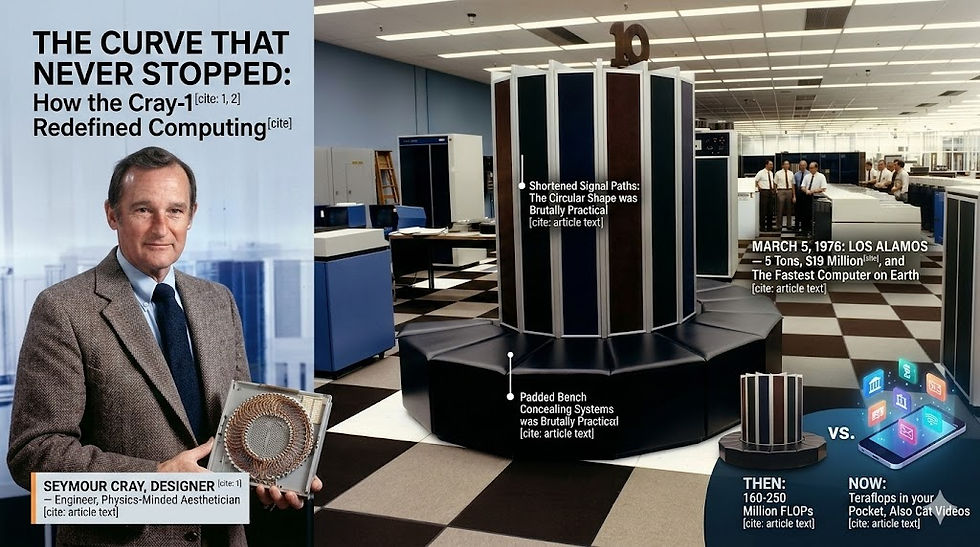

On March 5, 1976, something extraordinary arrived at Los Alamos National Laboratory. It weighed more than five tons, cost roughly $19 million, and looked like a piece of futuristic furniture designed by someone who understood both physics and aesthetics.
It was the Cray-1, designed by legendary engineer Seymour Cray, and at the time it was the fastest computer on Earth. The machine could perform roughly 160–250 million floating-point operations per second. That number might not sound impressive today, but in the 1970s it was almost unimaginable. The Cray-1 allowed scientists to model nuclear reactions, simulate atmospheric systems, and run complex physics calculations that previously would have taken years — if they were even possible at all.
This wasn’t just a computer. It was the bleeding edge of human capability.
A Physics Lesson Disguised as Industrial Art
The thing about the Cray-1 is that it didn’t just work brilliantly.
It looked brilliant. The iconic circular shape wasn’t an aesthetic flourish. It was the result of a brutally practical engineering insight: latency is governed by physics.
Electrical signals travel through wires at finite speeds. As computers become faster, the distance those signals must travel becomes a limiting factor. Seymour Cray understood this. Instead of building a machine with long cable paths stretching across racks, he wrapped the architecture inward, shortening the distance between components.
The machine literally curved itself around the problem of latency.
Even the famous padded bench surrounding the base wasn’t just a place for engineers to sit while debugging code. It concealed wiring, power supplies, and refrigeration systems needed to keep the machine stable.
The Cray-1 was a perfect example of what happens when engineering respects physics. It turned signal propagation and thermal management into something that almost looked like a sculpture explaining how computers work.
Now Fast-Forward Fifty Years
Let’s put that moment into perspective.
In 1976:
• A supercomputer cost $19 million
• It weighed five tons
• It required industrial refrigeration
• It lived inside national laboratories
Today, the device in your pocket can outperform it by orders of magnitude.
A modern smartphone GPU can deliver multiple teraflops of compute performance, which means a single phone can rival the compute power of tens of thousands of Cray-1 supercomputers and it runs all day on a lithium battery you charge next to your bed.
Think about that for a moment.
One of the most advanced machines humanity had ever built now fits comfortably inside the device you use to check the weather.

Yes, We Watch Cat Videos
And memes and late-night doomscrolling. That part is funny, but it’s also only the surface layer of what’s really happening. Because beneath the cat videos, something much bigger is going on. The world now runs on the descendants of the Cray.
Your phone manages:
• your banking
• your identity
• your communication
• your navigation across the planet
• your access to knowledge• your photos, memories, and media
For billions of people, the smartphone is no longer a secondary device.
It’s their primary computer. Internet traffic today is dominated by mobile devices. Entire businesses operate from them. Entire careers depend on them. The computing power that once existed only in a national laboratory now exists in billions of pockets around the world. That’s not just technological progress. That’s civilizational infrastructure.
Here’s the Truly Strange Part
This entire article started on one of those devices. I saw a post about the Cray-1, took a screenshot on my phone, dictated some thoughts into the microphone, and handed the ideas off to an AI to help shape them into something readable. All of it happening on a device sitting in my hand.
A device that’s tens of thousands of times more powerful than the machine that once represented the absolute peak of human computing. Think about that for a second. A pocket computer more powerful than a 1976 supercomputer… being used to dictate ideas… to an artificial intelligence… about the history of supercomputers. If that doesn’t bend your brain a little, it probably should.
A Nerd Moment About the Cray
I absolutely love the Cray-1. Not just because it was powerful. Because it taught the world something fundamental. It showed that the biggest breakthroughs in computing aren’t always about raw processing power. Sometimes they come from understanding the deeper constraints:
Latency.
Signal propagation.
Heat.
Power density.
The Cray-1 made those constraints visible. It turned them into architecture. Into engineering. Into something that almost looked like a museum piece explaining the physics of computation.
Honestly, one day I’d love to build a modern computer inside a full Cray-1 chassis and put it in the house as a functional piece of technology art.
Not a museum display. A working system. Call it a household HAL-9000. A reminder that some of the most elegant engineering solutions ever built came from simply respecting the laws of physics.
The Curve Didn’t Stop
The Cray-1 was the pinnacle of computing in 1976. But the curve it helped start didn’t flatten. It accelerated.
Today, the world’s most powerful computers don’t sit in laboratories.
They sit in AI data centers. Warehouse-scale computing environments filled with thousands of GPUs, linked by ultra-low-latency networks, fed by megawatts of electricity, and cooled by increasingly sophisticated liquid cooling systems. In many ways, these facilities are the spiritual descendants of the Cray.
They solve the same problems:
Latency.
Heat.
Power delivery.
Signal distance.
The physics didn’t change. We just kept pushing the limits.
The Real Bottleneck Now
And here’s the twist. Today, the biggest challenge in computing isn’t building faster processors. It’s power.
Modern AI infrastructure requires staggering amounts of electricity and advanced cooling systems to keep it operational. Compute has become so powerful that the real frontier now lies in how we generate, deliver, and manage energy for these machines. In other words: The future of computing is no longer just about chips. It’s about power plants, cooling systems, and infrastructure. The supercomputer problem has quietly evolved into an energy problem.
Happy Birthday, Cray
The Cray-1 didn’t just represent the fastest computer of its time.
It represented a moment when engineering, physics, and imagination collided and pushed the boundary of what machines could do.
Fifty years later, the descendants of that machine are everywhere.
In our pockets.
In our homes.
In our cars.
And in the massive AI infrastructure quietly reshaping the future.
Which brings us to the final perspective.
The Cray-1 put supercomputers in laboratories. Smartphones put them in our pockets. AI data centers are putting them everywhere. And the next revolution won’t be about faster computers. It will be about how we power them.
Happy birthday, Cray. You didn’t just build a computer. You started an exponential chain reaction.


Comments