
Have You Met Lisa Piccirillo? She Can Spin the Room.



So I walk into your office on a Monday morning and say, "You ever heard of Lisa Piccirillo?"
You probably say no.
Good.
Neither had I.
Someone told me I needed to look her up.
That was basically the entire instruction.
No setup. No explanation. No, "You'll like this because…"
Just: Lisa Piccirillo.
So I did what anyone does when somebody drops a random name on you with that kind of confidence.
I looked her up. And, honestly, I had absolutely no idea what I was expecting.
Someone sends me a name out of nowhere, in my world I'm probably assuming it has something to do with AI, technology, some company, some weird new researcher, some person I'm apparently supposed to know.
And if someone just drops a woman's name with no context at all, there's also a nonzero chance I'm about to discover that one of my friends has sent me an actress, an influencer, or something considerably less academic.
What I wasn't expecting was:
Lisa Piccirillo, mathematician. Low-dimensional topology. Knot theory. Four-dimensional manifolds.
Okay.
This has absolutely nothing to do with me.
Except about thirty seconds later, it suddenly had everything to do with me.
Because the more I read about Lisa Piccirillo, the less interested I became in the fact that she was a mathematician.
Which sounds ridiculous.
She's obviously a mathematician.
A very, very good one.
Top-shelf mathematician.
But after a few minutes, "mathematician" started feeling like an oddly small description of whatever was actually going on here.
It tells you where her mind operates.
I'm not sure it tells you what her mind does.
And that's where this story gets interesting.
Piccirillo became widely known because of a problem involving something called the Conway knot.
You don't need to understand knot theory for this story.
I certainly don't understand knot theory well enough to teach it to anybody.
The important part is that mathematicians had been staring at one particular question involving this knot for roughly fifty years.
The question was whether the Conway knot was "slice."
Again, the technical definition isn't important for what grabbed me.
What matters is that this was a real, serious, longstanding mathematical problem.
People knew about it.
Extremely capable people had worked on it.
The available machinery had been applied to it.
And it remained unresolved.
Then Lisa Piccirillo, while she was still a graduate student, hears about the problem at a conference.
She gets curious.
She starts playing with it.
And within days, she sees a path through something that had been sitting there for approximately half a century.
That's extraordinary.
But that's still not the part that got me.
The part that got me was how she approached it.
Because most of us, when somebody hands us a problem, accept two things without realizing it.
We accept the problem.
And we accept the way the problem has been presented to us.
That second part is sneaky.
Here's the object.
Here's the vocabulary.
Here are the normal tools.
Here are the boundaries of the discipline.
Here's what everybody else has tried.
Now go solve it.
And if the problem is difficult, we usually respond by doing some version of the same thing harder.
We study more.
We get better tools.
We calculate more.
We become more expert.
We walk around the object from another angle.
We climb on a chair.
We shine a brighter light on it.
We become incredibly good at navigating the room.
Piccirillo did something else.
Instead of continuing to attack the Conway knot directly, she worked with something called its trace, a related four-dimensional object.
Then she constructed another knot that shared the relevant trace but could be interrogated in a way the Conway knot apparently couldn't.
And that's where I stopped.
Because that's not just "really good at math."
That's a different move entirely.
She didn't walk around the room.
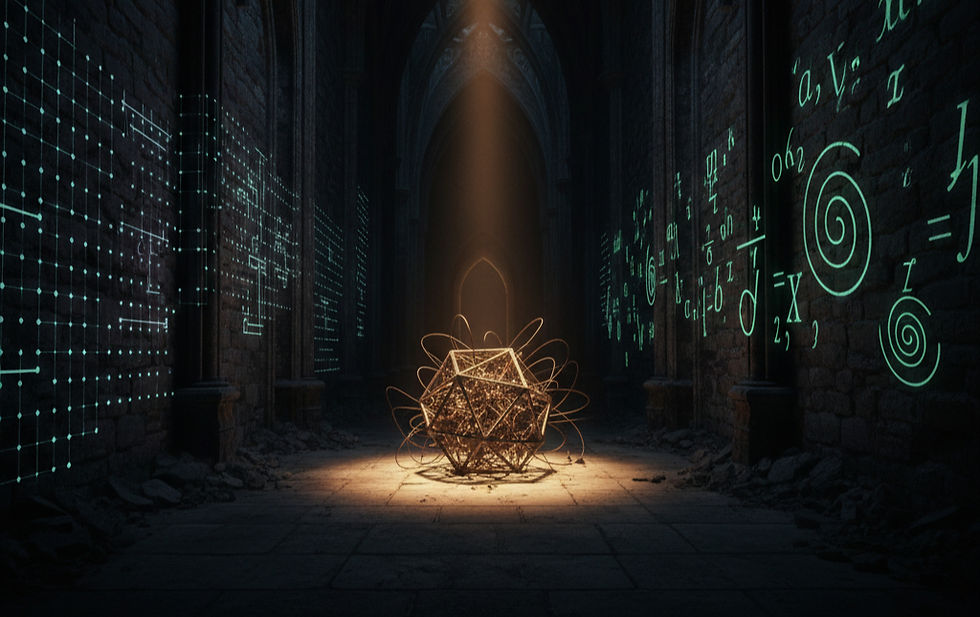
She spun the room.
That's the best way I know how to describe it.
Imagine an object sitting in the middle of a room.
People have spent fifty years walking around it.
They've looked at it from the front.
From the back.
From the sides.
They've built better instruments.
They've measured it more precisely.
They've catalogued every strange thing it does when viewed from every reasonable direction.
And then somebody walks in and, instead of moving herself to get another angle, grabs the entire coordinate system and rotates it.
Same underlying reality.
Different representation.
And suddenly something that had been hidden becomes visible.
That's the Lisa Piccirillo part that I can't stop thinking about.
And once I saw it that way, I started wondering whether calling her a mathematician is a little like calling Miles Davis a trumpet player.
Sure.
Technically.
But are we really naming the interesting thing?
Maybe mathematics is simply where this particular kind of mind happened to become visible.
Maybe she could have ended up in physics.
Engineering.
Computer science.
Architecture.
Something else entirely.
Maybe "mathematician" is the consequence, not the source.
Maybe the real thing happened farther upstream.
Maybe she possesses an unusual ability to separate reality from the representation being used to describe it.
That's much more interesting to me.
There's an old science-fiction word that fits unusually well here.
Grok.
Robert Heinlein introduced the word in Stranger in a Strange Land, and people usually translate it as "understand," but that feels too weak.
To grok something isn't simply to know things about it.
It's to understand it deeply enough that its structure begins to live inside your own thinking.
You can rotate it mentally.
Invert it.
Translate it.
Pull it apart.
Recognize which pieces are fundamental and which pieces exist only because somebody chose a particular way to describe the thing.
You stop memorizing the map.
You start understanding the terrain.
And that's what I think fascinates me about Piccirillo.
She seems to have been able to grok the problem deeply enough that the problem's presentation stopped having authority over her.
That's a very different kind of intelligence.
It's not just knowing more.
It's not calculating faster.
It's not having a larger vocabulary.
It's being able to see the structure beneath the representation.
And I want that.
Seriously.
I want Lisa Piccirillo sauce.
I want Piccirillo pills.
I want somebody to formulate whatever cognitive contraband allows a person to walk up to a fifty-year-old problem and not feel particularly obligated to respect the fifty years.
Because that's the goal.
At least it is for me.
I don't want to know the most things in the room.
There's always going to be someone who knows more.
Increasingly, that someone is going to be a machine.
I want to understand something deeply enough that I can recognize when the room itself is misleading me.
I want to look at a system and see beneath the interface.
Look at an industry and see beneath the business model.
Look at a technology and see beneath the product category.
Look at a problem and know when I'm looking at reality versus one convenient representation of reality.
Those aren't the same thing.
We confuse them constantly.
And once we do, we can spend years becoming exceptionally good at solving the wrong version of the problem.
A few hours into reading about Piccirillo, I finally went back to the person who had sent me her name.
I asked the obvious question.
Why her?
Why did you think I needed to know about Lisa Piccirillo?
He sent me a link.
It was my own link.
To something I had written called The Cave by the Ridge.
And I laughed.
Okay.
Now I understood.
Because in that piece I had been circling around this exact problem.
The prisoners in Plato's cave aren't necessarily stupid.
They're constrained by their angle.
If you spend your entire life looking at shadows on a wall, you can become extraordinarily sophisticated at interpreting shadows.
You can develop better shadow-measuring tools.
You can establish entire disciplines around shadow analysis.
You can become famous for your ability to predict what the next shadow will look like.
And none of that changes the fact that you're still facing the wall.
The problem isn't intelligence.
The problem is the frame.
At first I thought Piccirillo was simply a great example of someone who escaped the cave.
Then the more I thought about it, the less that seemed right.
Because I'm not sure she escaped anything.
I'm not sure she was ever fully inside.
She wasn't the prisoner who finally turned around and discovered the opening.
She was the person standing there asking why everybody had agreed the wall was the only thing worth looking at.
That's a completely different archetype.
Some minds become experts at navigating a room.
Other minds somehow learn the room without ever granting the walls authority.
That distinction matters.
Especially now.
Because we're living through a moment when almost every conversation about intelligence turns into a conversation about artificial intelligence.
Which model is smarter?
Which benchmark did it beat?
Which jobs disappear?
When do we get AGI?
When does artificial intelligence surpass humans?
When does superintelligence arrive?
All legitimate questions.
But Lisa Piccirillo makes me want to ask a different one.
What exactly are we trying to become?
Because if the goal is remembering more, the machines win.
If the goal is calculating faster, the machines win.
If the goal is producing more text, more code, more images, more spreadsheets, more summaries, more analysis, that comparison is already becoming ridiculous.
Humans aren't going to win the AI era by becoming slower computers.
And maybe that was never the point.
The interesting part of intelligence isn't merely how much processing you can do.
It's recognizing when the processing is happening inside the wrong representation.
That's the Piccirillo move.
And this is the part I love most about her story.
She didn't need AI.
She did the thing I get excited about when AI does it.
She crossed the abstraction boundary.
She changed representations.
She treated the supplied version of the problem as optional.
She realized that the object everybody had been interrogating wasn't necessarily the object she needed to interrogate.
AI didn't solve the Conway knot for Lisa Piccirillo.
Lisa Piccirillo solved it.
Human brain.
No giant context window.
No agent swarm.
No frontier model.
No synthetic research team trying ten thousand approaches in parallel.
Just a human being capable of rotating the problem until something hidden became visible.
I love that.
Not because it proves some point about humans being better than machines.
That's boring.
It puts the machines in perspective.
It reminds us that the aspiration shouldn't simply be to build intelligence outside ourselves.
We should also be figuring out how to cultivate this kind of intelligence inside ourselves.
Maybe that's where AI becomes really interesting.
Most people are currently using AI at the level of:
Do this for me.
Write this email.
Summarize this document.
Make this spreadsheet.
Generate this code.
Useful.
Absolutely.
There's another level where you ask:
Help me understand this.
Teach me the physics.
Explain the mathematics.
Show me the competing arguments.
Connect these disciplines.
Better.
But I think there's another level above both.
Help me grok this.
Show me this problem from five different representations.
Tell me which assumptions I inherited without noticing.
Translate the problem into another discipline.
Give me an analogy that breaks my existing model.
Show me what I'm treating as a law that's actually just a convention.
Tell me what changes if we rotate the object.
Don't merely give me the answer.
Help me get close enough to the thing that I can eventually see why the answer exists.
That's a completely different relationship with artificial intelligence.
That's augmentation.
Not outsourcing cognition.
Expanding the geometry available to it.
And maybe that's the better benchmark for this whole AI era.
Not:
Can AI outperform Lisa Piccirillo?
Who cares?
The interesting question is:
Can AI help more of us become a little more Piccirillo-like?
Can it help us move between disciplines before expertise hardens into a cage?
Can it give us enough temporary access to someone else's conceptual toolbox that we can look back at our own field from a different angle?
Can it help us identify assumptions before they become invisible?
Can it help someone who was trained inside the cave recognize that the walls are optional?
Can it help us grok?
Because if it can, that's a use of artificial intelligence I want very badly.
We don't need more humans who are simply faster at walking around the room.
We need more humans capable of realizing the room can move.
So yes.
Lisa Piccirillo is a mathematician.
A phenomenal one.
But I still think the moniker is too small.
What I see when I look at her story is something closer to cognitive sovereignty.
Deep expertise without obedience to the frame.
Understanding without imprisonment.
The ability to distinguish the thing itself from the way the thing has been represented.
The ability to grok.
And in an era obsessed with making machines more intelligent, she feels like an extraordinarily useful human being to study.
Not because we all need to become mathematicians.
Because we should all want to become harder to trap inside somebody else's coordinate system.
We should all want to grok more.
We should all want, every once in a while, to look at the problem everyone else has spent years walking circles around and realize that we don't necessarily have to take another step.
Sometimes you don't need a better angle.
Sometimes you spin the room.

Rich Washburn is a technologist and strategist working at the intersection of AI, infrastructure, and capital. He is Managing Partner and Chief AI Officer at Eliakim Capital.


Comments