
What Can This Thing Really Do?



Someone mentioned John Gustafson to me today. I looked him up. And within about five minutes, I had one of those deeply humbling moments when you realize there's an entire person, body of work, and foundational argument sitting directly inside your intellectual field of vision — and somehow you've never seen it. Not forgotten it. Not vaguely encountered it years ago. Missed it entirely.
John L. Gustafson. Gustafson's Law. Massively parallel computing. Sandia National Laboratories. A fundamental argument about how we think about computational capacity that goes back to 1988. Nineteen eighty-eight!
I've spent most of my life around computers. I've pulled them apart, expanded them, networked them, repaired them, built businesses around them, and followed their evolution from solder smoke to silicon clouds. I've worked in infrastructure, cybersecurity, digital forensics, data centers, high-performance computing, and now artificial intelligence. And I didn't know this guy.
I feel slightly stupid about that. Actually, I feel properly stupid about it. But there's a good kind of intellectual humiliation — the kind that doesn't make you retreat, but instead reminds you that the landscape is much larger than whatever portion of it you've already mapped. This was one of those moments. Because the more I read about Gustafson, the more I thought: oh, I know this animal. Not the individual. I've never met him. The species.
A Law That Was Really an Argument
To understand why Gustafson hit me so hard, you've got to understand the argument he walked into.
For decades, one of the dominant ideas in parallel computing was Amdahl's Law, named for computer architect Gene Amdahl. At the risk of brutalizing the mathematics, Amdahl's Law tells us that the speed of a fixed computational job will ultimately be limited by the portion of that job that can't be divided among multiple processors.
You can throw more processors at the parallel part, but the serial part remains. Eventually, that serial bottleneck dominates the result. That's real. It's useful. It remains important.
But Gustafson noticed an inherited assumption hiding inside the way people were applying it: why must the problem remain the same size?
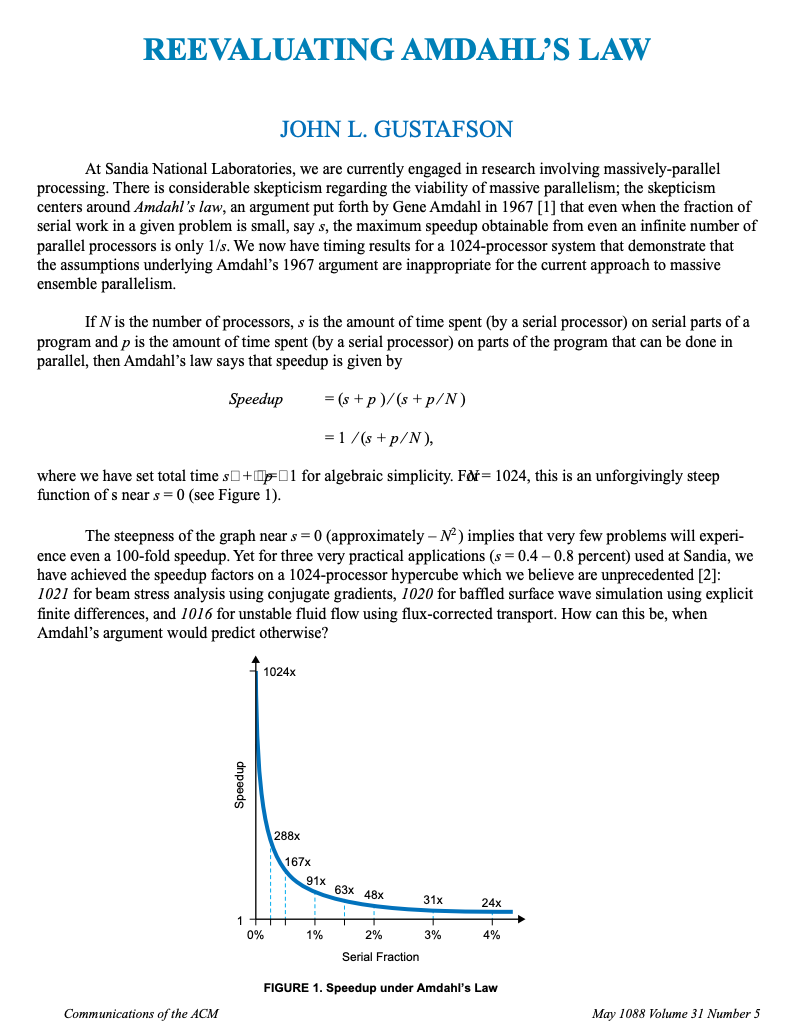
In his 1988 paper, Reevaluating Amdahl's Law, Gustafson argued that massively parallel systems shouldn't be judged only by how quickly they completed yesterday's fixed-size workload. In practice, scientists used additional computing power to solve larger and more detailed problems within roughly the same amount of time.
That sounds almost obvious today. It wasn't obvious then.
At Sandia, Gustafson and his colleagues were working with real scientific applications and a 1,024-processor system. The problem wasn't merely theoretical. They were confronting a new class of machine and an old way of evaluating it. Gustafson's paper described the prevailing interpretation of Amdahl's Law as creating a "mental block" against massive parallelism.
His answer was essentially: you're asking the new machine to solve an old-sized problem and then declaring the machine disappointing. That's not just a mathematical correction. That's a hacker move.
The Hacker as an Animal
I'm not talking cybersecurity hacker. I'm talking about the species. Two totally different layers — one is a job, the other is firmware.
Most people encounter a system and ask how to operate it correctly. The hacker turns it around, opens the cover, looks underneath it, and begins asking questions that may or may not have anything to do with its stated purpose. Most people ask how to work within the limits. The hacker relentlessly, creatively, and multidimensionally challenges the limits — for fun, curiosity, profit, mischief, or some internal compulsion that makes leaving them untested feel physically uncomfortable.
The hacker doesn't only push harder in the obvious direction. He rotates the problem.
Can the limit be bypassed? Can it be reframed? Can it be made irrelevant? Can this component be combined with another one? Can the system be miniaturized, enlarged, reversed, distributed, or used for something its designers never considered? Is the limit imposed by physics? Or software? Or architecture? Or economics? Or habit? Or did somebody make a decision 30 years ago that everyone else subsequently mistook for a law of nature?
That last category is where the interesting stuff lives. An inherited assumption is especially powerful because nobody currently involved remembers agreeing to it. It arrives embedded in the vocabulary, metrics, institutions, and tools. It no longer presents itself as a decision. It presents itself as reality.
Gustafson looked directly at one of those assumptions. The computing power had increased dramatically, but the imagined problem had been held artificially still. He didn't deny the constraint. He challenged the framing around it. That's high-priest hacker energy.
More Compute Should Buy More Ambition
Gustafson's Law is generally expressed as a scaled-speedup model. The technical point is that as processors are added, the parallel portion of a workload can grow, allowing a much larger problem to be solved in approximately the same elapsed time.
Amdahl asks: how much faster can we solve this fixed problem?
Gustafson asks: how much larger a problem can we now solve?
There's an entire worldview inside that distinction. When you gain new capacity, the goal shouldn't necessarily be to perform the same task slightly faster. The new capacity may allow greater precision. More variables. More scenarios. Higher resolution. Longer range. Better intelligence. Greater autonomy. More reach. An entirely different mission.
Once you get the thing to do the thing, any additional resources shouldn't merely allow it to keep doing the same thing under slightly more load. They should allow the thing to become more. That's not blind growth. It's not throwing processors, people, or money at a broken architecture and praying that scale will rescue it. Gustafson doesn't repeal coordination costs, serial bottlenecks, latency, or stupidity.
You can't add 100 people to a confused organization and expect 100 times the clarity. Sometimes you simply get 100 people waiting for somebody to tell them what the hell is happening. The underlying system has to be capable of converting resources into capability rather than friction. But once it can? Why would the objective be merely to maintain a flat line? A flat line isn't even flat. The world around the system is moving. Dependencies age. Competitors advance. Expectations rise. Security threats evolve. Technical debt compounds. Entropy keeps collecting its fee.
No progress isn't stability. No progress is decline with the lights still on.
New capacity must be converted into new capability faster than the surrounding environment converts it into maintenance overhead. Otherwise, every new resource disappears into organizational heat.
What Can This Thing Really Do?
This is where Gustafson's idea collided with something much older in me. I've been asking some form of the same question for most of my life: what can this thing really do?
That question has followed me from early computers and electronics to networks, batteries, aircraft, microcontrollers, data centers, and artificial intelligence. And, yes, occasionally something that can only reasonably be described as a battle chicken.
The object changes. The interrogation doesn't.
An ESP32 isn't merely a cheap microcontroller with Wi-Fi and Bluetooth. It may be a captive portal, a wearable, a sensor, a local control plane, a communication device, or the bridge that makes a supposedly dumb machine intelligent.
A battery isn't merely stored electricity. It's portability, independence, silent operation, resilience, range, and the removal of an entire class of constraints imposed by the cord.
A plane isn't merely something that flies. Change the propulsion, sensing, control system, endurance, payload, or mission and you begin changing what the aircraft actually is.
A working system isn't the finish line. It's the first moment the system becomes genuinely interesting. Most people get something working and experience relief: good, it's finished. The hacker experiences permission: good, now let's find out what it really is.
Moving the Emphasis
The more I thought about that sentence, the more I realized its meaning changes depending on where you put the emphasis.
What can this thing really do?
What can this thing really do?
What can this thing really do?
What can this thing really do?
What can this thing really do?
In Gustafson's 1988 context, the emphasis was largely on the scale of the doing. The machine was identifiable: a massively parallel computer. The question was whether we were giving it a problem large enough to reveal its power.
Today, with artificial intelligence, the emphasis has moved. Or perhaps it has spread across the entire sentence. We don't know the full range of the what. The can is conditional: once, reliably, autonomously, with tools, under supervision, at scale? The boundaries of this thing are unclear. Is the thing the model? The model with memory? The agent with tools? The agent connected to software, sensors, and other agents? The human-machine system formed around all of it?
The do now includes language, software operation, analysis, design, simulation, persuasion, planning, discovery, and increasingly the coordination of other systems.
But the word that's become radioactive is: really.
What can this thing really do?
With an older machine, undiscovered capability usually required adding something: memory, storage, a board, a peripheral, or a new piece of software. With AI, the capability may already be latent. You may discover it by changing the prompt. Changing the context. Connecting a tool. Providing memory. Adding an agent loop. Combining two capabilities nobody had previously thought to combine.
Every day, I pull another lever on one of these AI systems and find myself saying: well, shit. That's new. Sometimes the underlying model hasn't changed at all. The access path into its capability space changed.
That's why the word really matters more now than it ever has. We don't merely lack a complete list of what AI can do. We may lack the questions, workflows, interfaces, and conceptual categories required to reveal what it can do.
Gustafson asked whether we were giving the machine a problem large enough to expose its power. With AI, we may not yet be asking questions large enough — or strange enough — to reveal what kind of machine we've created.
He Kept Challenging the Frame
The part that makes Gustafson even more interesting is that he didn't stop with the law bearing his name. His career repeatedly returned to the same deeper instinct: challenge assumptions that the field has allowed to harden into inevitabilities.
He developed unums and later posits as alternatives to conventional floating-point representation, again asking whether a long-established computational standard should be treated as permanent simply because it had become conventional. His 2017 work presented posit arithmetic as a potential replacement for IEEE floating-point formats, continuing his broader effort to rethink how computers represent and calculate numbers.
He received three R&D 100 Awards for work involving computer-system performance, and his career has spanned national laboratories, academic institutions, and major technology companies.
Different problem. Same animal.
Find the assumption everyone has stopped seeing. Determine whether the limitation belongs to nature or merely to the current architecture. Change the frame. Build the alternative. Make the old boundary confess that it was never quite as solid as everyone believed.
There's a difference between reflexive contrarianism and this kind of thinking. The contrarian rejects the accepted answer because it's accepted. The hacker tests the accepted answer because it has stopped being questioned. Sometimes the limit survives the test. Fine. Now we know it's real. But sometimes the limit turns out to be convention wearing a lab coat. That's where progress happens.
A Blind Spot Worth Celebrating
So yes, I'm embarrassed that I didn't know John Gustafson's work. But I'm also thrilled. After a lifetime in and around technology, I can still encounter someone whose work immediately rearranges part of my internal map. That's a gift. It's evidence that there's more territory. And this particular territory feels strangely familiar.
Gustafson gave mathematical form to an instinct I've carried since I was a kid staring into machines: don't measure a new capability only by how efficiently it performs the old assignment. Don't assume the stated purpose is the final purpose. Don't spend every new resource merely preserving the present configuration. And don't accept a limit until you've determined whether it's physical, architectural, or merely inherited.
Amdahl showed us the bottleneck. Gustafson asked whether we'd made the surrounding problem too small.
That doesn't make one man wrong and the other right. They describe different questions. But there's something profoundly human in Gustafson's version.
Give us more capability and we don't merely want yesterday sooner. We want tomorrow to become larger.
An Open Invitation to John Gustafson
Dr. Gustafson, should this article somehow find its way to you, consider this an open invitation.
I'd genuinely love to speak with you. It doesn't have to be a formal interview. It doesn't have to be a podcast. It doesn't need an audience, a production schedule, or any particular purpose beyond curiosity. A private phone call would be fine. I simply want to pick your brain.
In 1988, you argued that additional computational capacity should enlarge the problem rather than merely accelerate the old one. Today, additional compute appears to be doing something even stranger. It may be expanding not only the scale of the workload, but the nature of the capability, the identity of the machine, and the range of problems we can imagine assigning to it.
Does Gustafson's Law still capture that? Or are we entering territory that demands another reframing? I have questions. Many of them. Most begin with the same six words that have been following me throughout my life: What can this thing really do? And now I want to know how John Gustafson would emphasize the sentence.

Rich Washburn is a technologist and strategist working at the intersection of AI, infrastructure, and capital. He is Managing Partner and Chief AI Officer at Eliakim Capital.


Comments