
They Did It Again.


A follow-up to: How Do You Say “Sputnik” in Chinese?

Five months ago I wrote about Hanyuan-1 — China’s rack-mountable, room-temperature quantum computer that turned quantum from a physics experiment into an IT procurement decision. I said the signal was clear: China wasn’t just winning the qubit race. They were winning the adoption race. This week, they proved the point from a completely different angle.
A Different Machine. A Bigger Number.
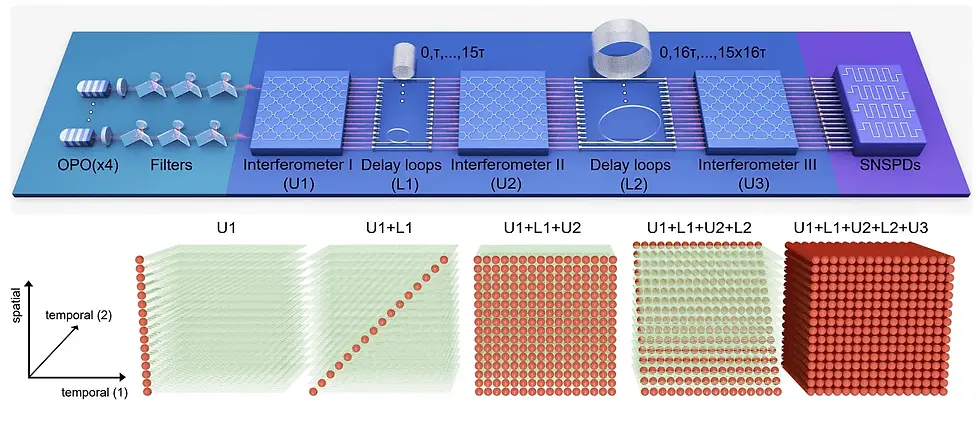
Jiuzhang isn’t Hanyuan. It’s not neutral atoms. It’s not a server rack. It’s photonic — it uses particles of light instead of electrons. Developed by Pan Jianwei’s team at the University of Science and Technology of China, it’s been iterating since 2020. The 4.0 version just ran a Gaussian boson sampling calculation in 25.6 microseconds.
The equivalent classical simulation? 10⁴² years.
That’s not 2.6 billion years like the original Jiuzhang headline floating around social this week — that was the 2020 version. The new number is so large it barely registers as a number. The known age of the universe is roughly 10¹⁰ years. We’re talking 10⁴². That’s not a performance gap. That’s a different category of reality.
Same Country. Different Architecture. Same Pattern.
Here’s what’s notable: China isn’t betting on one approach. Hanyuan-1 is neutral atom. Jiuzhang is photonic. Zuchongzhi 3.0 — announced in March — is superconducting, 105 qubits, competing directly with IBM and Google.
They’re running three separate quantum architectures simultaneously. At scale. With state backing and $15 billion in committed funding.
The U.S. has more private capital and more talent density. But China has coordination. And in a race that requires a decade of parallel bets, coordination is a structural advantage.
The Narrow Problem Problem
Full disclosure: Gaussian boson sampling is a specialized task. Jiuzhang 4.0 is not a general-purpose quantum computer. It can’t break encryption, optimize supply chains, or run Shor’s algorithm. It does one narrow thing — and it does it in a way that classical computers cannot touch. But that’s exactly how every transformative technology starts. GPS was originally military and single-use. The internet was a DARPA project for academic packet routing. The first transistor couldn’t do much either. You don’t judge a trajectory by the first mile.
What the Scoreboard Actually Looks Like
In the last 90 days out of China: Hanyuan-1 — room-temp, rack-mounted, 100-qubit neutral atom system. Already shipping to customers.
Zuchongzhi 3.0 — 105-qubit superconducting system. Benchmarks claim 1 million times faster than Google’s best.
Jiuzhang 4.0 — photonic, 1024 squeezed states, classical equivalence of 10⁴² years.
Three systems. Three architectures. Ninety days.
I’ll ask the same question I asked in November: How do you say Sputnik in Chinese?
Because they’re not just answering that question anymore. They’re asking us if we heard the beep.


Comments