
The World's Largest Data Center Just Got Killed by a Typo

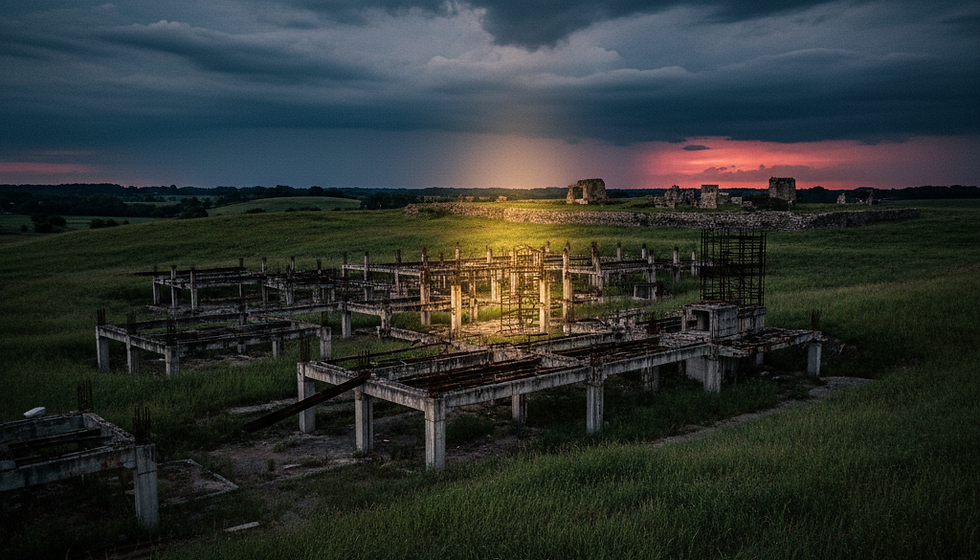
The Prince William Digital Gateway collapse isn't just a real estate story. It's a warning shot for the entire industry.
Yesterday, Compass Datacenters quietly walked away from one of the most ambitious infrastructure projects in American history. No dramatic announcement. No press conference. Just a statement from their president acknowledging that "recent legal actions and compounding regulatory hurdles have effectively closed a viable path forward."
That's a polite way of saying: billions in committed capital, years of planning, and 22 million square feet of data center capacity — gone.
And here's the part that should make every developer in this space sit up straight: it wasn't killed by environmentalists. It wasn't killed by the Manassas battlefield preservation groups, though they fought hard. It wasn't killed by a hostile state legislature or a federal agency.
It was killed by a botched public notice requirement on a zoning hearing.
What Was the Prince William Digital Gateway?
Scale matters here. This wasn't a regional data center project. This was the largest planned data center campus on Earth.
- 22 million+ square feet of data center space - 37 individual facilities across 2,100 acres near Gainesville, Virginia - Up to 9 gigawatts of power consumption — enough to power over 2 million homes - Two lead developers: Compass Datacenters (Brookfield-backed) and QTS (backed by Blackstone and Global Infrastructure Partners) - Nearly 100 landowners who sold or agreed to sell their properties — farms, horse properties, family homes — to make the assemblage possible
In December 2023, the Prince William County Board of Supervisors approved the rezoning after a 27-hour board meeting. Community opposition was massive. Legal challenges were filed almost immediately.
Then, in August 2025, a Virginia Circuit Court judge voided the entire rezoning. Not on environmental grounds. Not because of the battlefield. Because the county had failed to properly advertise the public hearing before the vote.
The Virginia Court of Appeals affirmed that ruling on March 31, 2026.
Compass announced yesterday they won't appeal further. As of today, QTS faces a deadline to appeal to the Virginia Supreme Court — and early reports suggest they intend to continue the fight. But with the county already having withdrawn from the lawsuit two weeks ago — after spending $1.7 million in taxpayer funds defending the developers — the political infrastructure behind this project has evaporated.
The Procedural Kill Shot
The legal mechanism that brought this down deserves attention, because it's going to be studied.
Virginia law requires that public hearings on zoning changes be properly advertised in advance — specific notice requirements, specific timelines, specific formats. The county failed to meet that standard before the December 2023 vote. That single procedural failure was enough to void the entire rezoning. Not to delay it. Not to require a do-over. To void it entirely, as if the vote never happened.
The lead plaintiff attorney described it as having "an Erin Brockovich feel to it" — a ragtag group of community volunteers who showed up at the government center on December 11, 2023, to protest, who eventually found a good attorney and a procedural argument that the multi-billion-dollar data center industry couldn't answer.
The American Battlefield Trust called Compass's exit a victory for "the rule of law." They're not wrong. But they're also underselling what actually happened here.
What actually happened is that a community with no institutional power, no political relationships, and no money found the one lever that worked — and pulled it.
That is now the playbook.
What the Collapse Signals
There are four implications here that matter beyond Prince William County.
The permitting and zoning risk premium just got repriced.
Every data center developer running greenfield site analysis now has to model legal defeat as a real scenario, not a tail risk. Not a 5% probability in a Monte Carlo. A real outcome that can erase years of investment and hundreds of millions in sunk costs. Any site that requires aggressive rezoning near residential communities or heritage sites carries that exposure.
The behind-the-meter model gets structurally stronger.
Industrial sites with existing power infrastructure, existing industrial zoning, and no public utility dependency bypass this entire category of risk. The regulatory surface area is smaller. The community friction is lower. The path from contract to construction is shorter. When hyperscale greenfield projects collapse like this, the relative attractiveness of retrofit and behind-the-meter approaches increases — not just economically, but operationally.
Displaced demand has to land somewhere, fast.
Compass and QTS had committed customers expecting multi-gigawatt capacity in one of the most strategically important markets in the world. Northern Virginia is already the most constrained data center market on Earth — the highest concentration of hyperscale capacity anywhere, and still chronically undersupplied relative to demand. That capacity need doesn't evaporate. It redirects. Operators sitting on shovel-ready, permit-clean capacity in the region have a window right now.
The political environment is moving faster than the industry expected.
A Washington Post and Schar School poll from two weeks ago documented something remarkable: public support for new data centers in Virginia — the most data-center-dense state in the country — collapsed from 69 percent in 2023 to 35 percent in 2026. In three years. That is not a slow drift. That is a sentiment collapse.
Community consent is no longer a formality to be managed. It's a variable that can kill a project. The national security and China-competition framing — what I've been calling the Wonder Valley playbook — is the industry's counter-move. But it only works in specific geographies with military adjacency, federal backing, or communities that haven't yet had time to organize.
Prince William County had all of those advantages and still lost.
The Landowners Nobody's Talking About
There's a quiet tragedy buried in this story that deserves a moment.
Mary Ann Ghadban is the Gainesville horse farm owner and commercial developer who spent years assembling the land coalition that made the Digital Gateway possible. She rallied nearly 100 of her neighbors — farmers, families, longtime residents — to agree to sell their properties to QTS and Compass. She believed in the project. She put her land and her relationships on the line for it.
She is now suing QTS in federal court to get out of her sales contract. Four other landowners joined her.
They are trapped in contracts for land that can no longer be developed as planned. The project is functionally dead for Compass. QTS is fighting on at the Virginia Supreme Court level — but with no county backing, no co-developer, and eroding political cover, the odds are not what they were in 2023.
These are the people who believed the promises. Who rearranged their lives around an outcome that didn't come. The industry doesn't talk about them much. It should.
The Bottom Line
The Prince William Digital Gateway was supposed to be a monument to the scale of American AI infrastructure ambition. 22 million square feet. 37 data centers. 9 gigawatts. The largest campus of its kind on Earth.
It was stopped by a procedural notice violation and a ragtag group of homeowners who found a good lawyer.
That sentence should be required reading for every site selection team, every zoning attorney, every capital allocator writing checks into greenfield data center development right now.
The demand for compute infrastructure is not going away. The pressure to build is not going away. But the rules of engagement just changed — permanently. Communities know how to fight this now. They have a playbook. They have a precedent.
The developers who figure out how to build with communities instead of around them are going to win the next decade. The ones who keep trying to brute-force rezoning through political relationships and 27-hour board meetings are going to keep losing — one procedural notice at a time.



Comments