
The Trillion-Dollar Search Query
- Rich Washburn

- 1 day ago
- 5 min read


This is getting ridiculous.
Yesterday I wrote about what happens when AI makes the search space of physical reality economically explorable. The basic argument: almost every major engineering bottleneck eventually becomes a materials-science problem, and AI combined with simulation and automated laboratories is starting to let us search for new materials instead of waiting decades for someone to stumble across them.
Today I watched a video about the Salton Sea.
There may be an enormous domestic lithium resource sitting under a toxic lake in the California desert. Geothermal plants are already bringing lithium-rich brine to the surface every day. The problem is that the brine is roughly 600 degrees, obscenely corrosive, and so mineral-heavy that it clogs and destroys the equipment needed to extract the lithium. Pipes that would last 10 years in a normal geothermal plant might need replacing every 18 months here.
So naturally, my immediate thought was: great, we just need to spin up an AI materials-science agent, invent some advanced ceramic coatings, solve high-temperature geothermal corrosion, and have the prototype ready by lunch. I was joking.
Mostly.
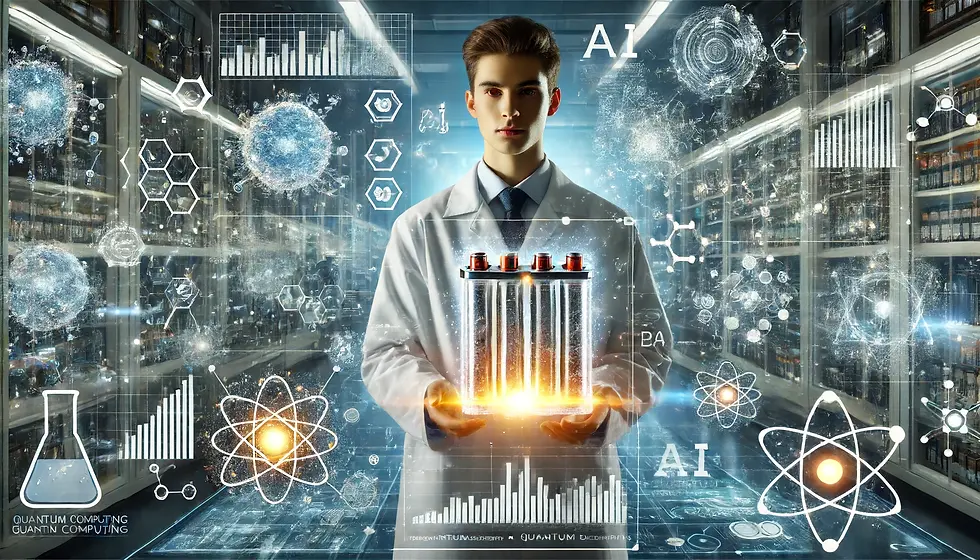
Then I remembered that I already wrote about Microsoft and PNNL using AI and high-performance computing to reduce a search space of roughly 32 million candidate battery materials to 18, and then produce a working battery material using 70% less lithium. That was back in 2024. The important part wasn't the battery chemistry. It was that AI made a previously impractical materials search economically navigable.
So apparently, this is where we are now. We identify a brutal physical constraint that has frustrated engineers for decades, laugh about "agentifying" it — and then realize the first pieces of that exact machinery already exist.
THE JOKE THAT ISN'T FULLY A JOKE
The Salton Sea problem is a vicious combination of temperature, pressure, chloride corrosion, silica scaling, erosion, and constantly shifting brine chemistry. DOE literature describes geothermal brines as hot, corrosive, and scaling-prone. The lithium extraction process also requires removing interfering minerals like silica and iron before lithium recovery can work. It's not one problem. It's six problems stacked on top of each other in a 600-degree soup.
What you'd want isn't a bot that says "use ceramic because ceramic handles heat." You'd want an AI materials-engineering agent that designs and continuously optimizes the entire brine-contact system: ceramic and ceramic-composite liners, corrosion-resistant coatings, filtration membranes, valve seats, pump components, nozzles, heat-exchanger surfaces, anti-scaling surface textures, and sacrificial replaceable wear components.
Given this exact brine chemistry, temperature, pressure, flow rate, and component geometry: design the cheapest material system that survives long enough to make the plant economical. And the answer probably isn't "make the whole pipe out of exotic ceramic." Large structural ceramics can be brittle, difficult to join, expensive to manufacture, and vulnerable to thermal shock. The winning architecture is more likely ordinary structural metal, an engineered bond layer, a thin ceramic-composite barrier, and replaceable ceramic wear inserts. Potential material families include alumina, zirconia, silicon carbide, silicon nitride, and ceramic-metal composites — each needing testing against the actual brine. Even alumina coatings that look promising in neutral geothermal environments can chemically transform or delaminate under different pH conditions. There is no universal miracle material. There's a search problem.
THE LOOP THAT MAKES IT REAL
The bot becomes genuinely valuable when it closes the loop. Ingest live brine composition and operating conditions. Search known alloys, ceramics, coatings, and joining methods. Run thermodynamic, corrosion, scaling, and fluid simulations. Generate candidate material stacks and component geometries. Send recipes to additive manufacturing or coating equipment. Evaluate test coupons using microscopy and sensor data. Learn from failures. Generate the next formulation.
That's an autonomous materials laboratory aimed at one trillion-dollar bottleneck.
And here's the part that's even more interesting. The AI shouldn't only try to resist the silica and mineral precipitation. It should explore how to control and weaponize it. Research has shown that silica can potentially be deliberately precipitated from geothermal brine into usable silicate materials — simultaneously reducing scaling downstream and creating another product stream.
So the system becomes: geothermal electricity plus lithium plus engineered silica products plus cleaner brine plus longer-lived equipment.
That's much more interesting than "AI invents a better pipe." It's an AI agent tasked with turning the brine's worst characteristics into materials, coatings, and commercially valuable outputs. The corrosive soup stops being merely the obstacle. It becomes the feedstock for the solution.
WHY THIS ISN'T JUST HYPE
Five years ago, this would have been an absurd joke. Spin up an autonomous materials-science lab, solve high-temperature geothermal corrosion, invent a new ceramic-metal composite, validate it under pressure, and have the prototype ready before lunch.
Now it's only mostly absurd.

The bot can already accelerate literature review, candidate screening, simulation setup, experiment design, and failure analysis. What it can't do is skip the part where matter has opinions. Real brine at 600 degrees doesn't care about your simulation. It corrodes what it corrodes. It scales where it scales. The physical world tests every candidate, and most of them fail. But that's exactly the point of The Search Space argument. The value of AI in materials science isn't that it replaces physical testing. It's that it narrows the search enough to make the testing tractable. You go from "try everything" to "try the 18 things that survived the simulation." That's the difference between decades and months.
THE PATTERN
Here's what keeps happening. I write about a structural shift. The next day, reality hands me a case study.
The Search Space argued that AI makes physical reality economically explorable — that we're entering a period where the bottleneck isn't discovering what's possible but searching the space of what's possible fast enough to act on it.
The Salton Sea is the perfect test case. Half a trillion dollars of lithium sitting under a toxic lake. The lithium is confirmed. The geology is solved. The extraction method is understood. The only thing standing between the US and a domestic lithium supply is a materials problem: find something that can survive the brine long enough to make the plant pay for itself.
That's not an AI problem. It's not a geology problem. It's a materials search problem — exactly the kind of problem AI is starting to make tractable.
The joke about "agentifying" it is aging considerably faster than I expected. The machinery doesn't exist yet in the form that would actually solve this. But the pieces are on the bench. Microsoft and PNNL already proved the concept with battery materials. The Salton Sea just gives it a nastier, more commercially enormous target.
Find a material stack that can survive the soup. That's the trillion-dollar search query. And we're getting better at running the search faster than the soup is getting worse.

Rich Washburn is a technologist and strategist working at the intersection of AI, infrastructure, and capital. He is Managing Partner and Chief AI Officer at Eliakim Capital.


Comments