
The Daily 15: Am I Crazy?



I think I may have accidentally started doing something.
I'm still not entirely sure what it is, which is usually when I know I'm interested.
For now, I've been calling it The Daily 15.
The idea is ridiculously simple: Find one thing worth fixing. Spend about fifteen minutes. Do something useful. Give it away. Move on.
Not tell somebody what they should do. Not give them a "free audit." Not send them one of those LinkedIn messages that starts with, "I noticed your impressive background..." and mysteriously ends with a Calendly link.
Actually do the thing. Build something. Fix something. Reframe something. Preserve something. Make something useful that did not exist fifteen minutes earlier and hand it to somebody.
There was no grand plan behind this. In fact, the first one was basically an accident caused by insomnia.
The first one was Rachel Morris. And I want to be clear: there was no Daily 15 at that point. No name. No concept. No intention of doing a second one.
It was somewhere around 1 a.m. I was lying in bed scrolling LinkedIn, operating on too little sleep and probably questionable judgment, when I came across Rachel openly asking for help finding work.
Her post was getting the normal LinkedIn response. Reactions. Shares. Encouragement. People saying they hoped something worked out. All perfectly decent human responses.
But something about it bothered me.
I grabbed what I could see from Rachel's post and professional background and started running it through the collection of AI tools I use every day — research tools, reasoning models, writing systems, design tools, development platforms.
The question was basically: Who is this person really, and are we seeing her correctly?
Once I started looking at Rachel's actual experience, the problem became obvious. Her real capability was substantially stronger than the signal she was sending.
She had experience across quality assurance, product quality, technical operations and support. But what the market was seeing was the familiar shape of somebody on LinkedIn saying: Please give me a chance.
That wasn't really the story. The market was seeing a weak signal for a much stronger person.
So I started working the problem. I used the tools to analyze her background, find the professional through-line, reorganize the way her experience was presented, refine the language, work through the visual treatment and eventually build something tangible that somebody else could actually share. And I want to be careful here, because I don't want the lesson to become: "Paste somebody's LinkedIn into ChatGPT and fifteen minutes later this happens." That would be misleading.
I use a fairly mature collection of AI systems. Different models for different jobs. Research tools. Development platforms. Systems that carry a lot of context about how I think and what I tend to look for.
I move work between them. I massage outputs. I argue with them. I throw things away. There's judgment involved.
Someone could take exactly the same information, type something into an AI model and produce something brilliant. They could also produce absolute garbage.
The interesting part isn't some magical prompt. The interesting part is what has become possible when human judgment is paired with enough AI leverage that the execution cost collapses.
In Rachel's case, a little while later there was a professional site that told a much better story about who she actually was. And that changed the object people could share.
Before: Rachel needs a job.
After: Here is Rachel. Here is what she can actually do. Here is something
you can send directly to somebody who might need her.
I dropped the link into the LinkedIn conversation. And I genuinely thought that was the end of it. It was a one-off.
Then the damn thing started moving.
The accidental prototype
The last time I checked, the comment and link around Rachel's page had circulated on the order of 120,000 times.
That's ridiculous. Not because I think I'd created some masterpiece. I hadn't. I had spent a relatively tiny amount of time fixing what looked like an obvious mismatch.
But suddenly a very large number of people had something more useful to act on than sympathy. They could inspect Rachel. Forward Rachel. Send her page to a hiring manager. Drop it into an internal Slack channel. Text it to a friend. Say: "You should talk to this person."
And that got me thinking about the reactions on the original post. More than a thousand people had acknowledged what Rachel was going through. That's nice. But imagine if only ten percent of those people actually did a thing. Made a call. Sent an email. Forwarded her information. Made an introduction. Referred her internally. That would be a hundred actual interventions.
There's a huge difference between acknowledgment and movement. Reaction is cheap. Action is useful.
And once I saw it that way, LinkedIn started looking different to me.
LinkedIn is a routing network
We normally think of LinkedIn as a content platform, a résumé database, a recruiting tool, or a place where professionals perform professionalness at each other. But underneath all of that is an enormous human routing network.
The hiring managers are already there. The founders are there. The recruiters are there. The customers are there. The investors are there. The former coworkers are there. The person who knows the person who knows exactly the person you need is probably there.
The network already exists. Sometimes the missing ingredient isn't another reaction. It's a better object to route. That was what Rachel's page became. And that was the part I couldn't quite stop thinking about. So then I did what any completely normal person would do. I checked my token usage.
Token burn, but useful
I have a ridiculous number of AI tools. Different models. Different platforms. Different development environments. Different specialized systems. And like plenty of people who pay for too much software, I sometimes get toward the end of a billing cycle and realize I have capacity sitting around that I already paid for.
This has become something of a running joke with me. I've written before about token maxing — going around at the end of the month trying to burn unused AI capacity because, irrationally or otherwise, I hate watching it expire.
Usually that means experiments. Build something stupid. Test a model. Generate something ridiculous. Push a system until it breaks. Argue with an AI about something that absolutely didn't need twenty thousand tokens spent on it.
I'm exceptionally capable of wasting fifteen minutes. I do it every day.
And suddenly I had another thought: What if I burned some of that capacity on people instead?
That was really the beginning of the Daily 15. Not a strategy meeting. Not a nonprofit. Not a content calendar. Not a product launch.
I already had the tools. I already paid for the compute. I was already going to screw around with them. And Rachel had just demonstrated that a very small amount of effort on my side could, occasionally, create a wildly disproportionate effect on somebody else's side.
That seemed like a pretty good trade. So I went looking for another one.
Catrina
Catrina Milliman looked similar to Rachel at first. She wasn't.
Catrina had almost twenty years of experience in insurance and business. She had founded her own insurance agency. Built it to more than 2.8 million dollars in direct written premium. Managed relationships with roughly 2,600 clients. Maintained around 95 percent retention. Built processes. Trained employees. Developed high-net-worth relationships. Handled sales, retention, customer experience, risk and business development.
And yet she was publicly talking about potentially needing to start over. Trainee positions. Assistant roles.
That wasn't Rachel's problem. Rachel had underrepresentation. Catrina had misclassification. Her signal was effectively saying that changing industries erased twenty years of accumulated capability. It doesn't. Changing lanes doesn't mean returning to the starting line.
So Catrina's intervention became different. Different positioning. Different design. Different argument.
She didn't need a prettier entry-level résumé. She needed to be presented like what she actually was: an experienced operator changing domains with twenty years of horsepower already behind her.
That taught me something important. Different people require different signal repair. This could never become a template factory.
Then came Slava.
Engineer first
Slava Shevchenko is a Ukrainian frontend engineer living in Poland. His circumstances are objectively difficult. Disability. War. Displacement. Loss of stability. Financial pressure.
And that created another kind of problem. It would have been very easy to tell his story badly. Lead with the hardship. Emphasize the tragedy. Turn a highly experienced engineer into a charity case.
Except Slava has more than ten years of frontend experience. JavaScript. Vue. Nuxt. React exposure. SaaS. RegTech and crypto compliance. A previous Front End Lead role. Strong recommendations from managers emphasizing ownership, reliability, business awareness, judgment and clean code.
That was the professional signal that needed amplification. So his intervention became something I started calling: Proof of Engineer.
The website itself needed to function as evidence. His personal story belongs there. It matters. But it isn't the reason someone should hire him.
The governing rule became: Engineer first. Human story second. No pity positioning.
That gave me another principle I keep coming back to: Empathy may be what makes you notice somebody. Evidence is what should represent them.
Allison
Then came Allison Heath. Different again.
Allison's professional positioning was actually pretty strong. International Account Executive. High-ticket closer. Revenue. Authority. Consultative selling.
But underneath the headline, the evidence was fragmented. Years in healthcare. Outside sales. B2B account management. Strategic prospecting. Negotiation. High-ticket work. The pieces were there. The visitor was simply being forced to assemble the story themselves.
So Allison's problem wasn't that she was aiming too low. And it wasn't necessarily that her positioning was wrong. It was an authority-evidence gap. The claim was ahead of the visible proof.
So Allison became a Proof of Closer. Not a résumé. Not one of those horrifying sales-bro landing pages. No Lamborghinis. No stacks of cash. No CLOSE. DOMINATE. SCALE.
The question was simpler: Would I trust this person with an important prospect and a consequential sales conversation?
Her headline made the claim. The page needed to make the case. Different problem. Different artifact. Same underlying mechanism.
Signal repair
By then, I had enough examples that a pattern was becoming obvious.
Every person has some amount of real capability. Call that C. The outside world sees some representation of that capability. Call that S. Ideally, S is roughly equal to C — what the market sees is reasonably close to what's actually there.
But sometimes S is much less than C. The signal is materially weaker than the capability.
That gap happens for a hundred reasons. Some people are terrible at writing about themselves. Some are too humble. Some are desperate, and the desperation starts swallowing the professional story. Some are changing industries and don't know how to translate what they already know into the language of the next one. Some have years of increasingly sophisticated work buried underneath boring job titles. Some have tremendous capability and almost no visible proof. Some have been flattened by the résumé format itself. And sometimes the positioning is directionally correct, but the evidence underneath it is too scattered to make the argument.
The job isn't to manufacture capability. I don't want to turn everybody into a visionary transformational thought leader. I don't want to invent metrics. I don't want to create fake expertise. I don't want to make somebody sound impressive by making them unrecognizable.
The job is: Find the gap between the human and the signal. Then reduce it.
Richard and the flight instructor problem
And then the idea started leaking outside career profiles.
Richard is a flight instructor in Houston. He wanted more students. That's it. No dramatic career crisis. No misclassification. No terrible LinkedIn story. He simply had real capability on one side and potential students on the other, with unnecessary friction between them.
So the intervention became Fly Houston Pro. A customer-facing asset. A way for somebody considering flight training to find him, understand what he offers, build some trust and contact him.
That isn't quite career signal repair. It's closer to commercial friction removal. But the mechanism is almost identical. There's something valuable on one side. There's somebody who needs or wants that value on the other. The middle is broken. Fix the middle.
That started broadening the Daily 15 for me. The website itself wasn't the idea.
The website is incidental
This is important. The Daily 15 is not: Rich makes strangers free websites.
The website is merely one kind of artifact. Right now it happens to be an extremely powerful one because AI-assisted development has made producing a useful site absurdly fast compared with what it used to require.
But tomorrow the intervention might be: a better landing page, a rewritten offer, a one-page sales asset, an introduction, a positioning change, a small automation, a better explanation of somebody's technical work, fixing an obvious problem on a local business website. Maybe no website at all.
The unit of work isn't a webpage. The unit of work is: one observable mismatch I can materially improve in about fifteen minutes.
Or at least that's what I thought the definition was.
Then I tried to finish writing this article. And the whole idea changed again.
I couldn't finish this article because another Daily 15 happened
I'd been working on this piece earlier in the day. Then I had to stop because I had a business appointment in downtown Fort Lauderdale.
Afterward, a few of us were sitting outside. Cigars. A couple drinks. Talking too loudly about whatever people talk too loudly about after a couple drinks.
One of the guys at our table was telling a story about his daughter. At some point an older woman from another table walked over. For about three seconds we thought we were in trouble. We assumed she'd come over to tell us to shut up.
Instead, she said she'd overheard what he was saying about his daughter and just wanted to tell him that she thought it reflected well on him as a father.
That was it. A completely random human interaction. So naturally we started talking to her.
Her name was Julie. She was in Fort Lauderdale for business. And somewhere in the course of that conversation, she started telling me about her mother.
Her mother was Delia Weddington Stewart. And the story was extraordinary.
Delia
Delia was born in Mississippi in 1936. As a teenager, she went to New York. At fourteen, Radio City Music Hall. At sixteen, Broadway.
Later she returned South and brought some of what she'd learned with her. She helped build serious dance infrastructure on the Mississippi Gulf Coast. Founded Mississippi Coast Ballet. Later moved to Houston and built the Delia Stewart Dance Company and Center. She taught. She trained dancers. She created. She built institutions. She helped carry a language of movement from one generation into another.
Julie was sitting across the table telling me all of this. Not pitching me anything. Not asking me to make anything. She was just talking about her mom.
And somewhere in that conversation I got the same feeling I'd gotten with Rachel. Except the problem was completely different.
There's something here that should not disappear.
This time there was no job to get. No customer to acquire. No professional signal to repair. No commercial outcome whatsoever. This was memory. A life. A lineage. A collection of photographs, stories, programs, names, schools, dancers, places and relationships that existed in pieces across the memories of people who'd been there.
So I did what I apparently do now. I started working the problem. And what emerged was: deliastewart.space.
Not just a memorial page. A living archive. Her story. A timeline. Historical context. Audio. An archive that can expand. A place where former students, dancers, colleagues and friends can contribute their own memories. A structure designed to keep growing as photographs, programs, documents and stories are recovered.
The opening became: She didn't simply teach dance. She helped carry a language across generations. And the story ends with something that, by then, felt obvious: A dancer leaves the stage. A teacher remains in the bodies of the people she taught. Those people teach someone else. And eventually, no one remembers exactly where the movement began. But it began somewhere.
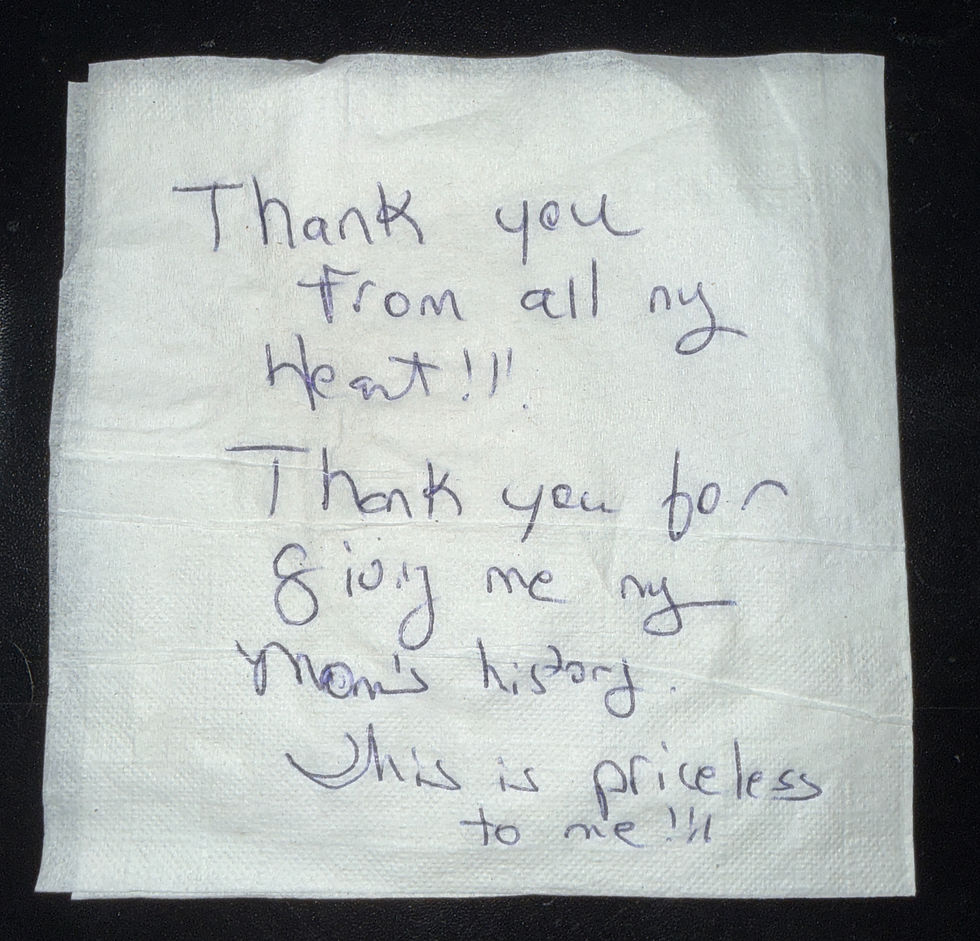
Later that night, Julie wrote me a note on a napkin. I took a picture of it. It said: "Thank you from all my heart!! Thank you for giving me my mom's history. This is priceless to me!!!" And that may have been the moment I finally understood the article I'd been trying to write all day.
I couldn't finish writing about the Daily 15... because another Daily 15 interrupted me. And this one had nothing to do with careers. Nothing to do with sales. Nothing to do with LinkedIn. It was about preserving something before it disappeared.
That broke my own definition. Maybe the thing I'm interested in isn't merely professional signal. Maybe it's human signal.
Maybe the problem is bigger than I thought
Sometimes the mismatch is: this person is more capable than the market realizes. Sometimes: this experienced person thinks changing careers means starting from zero. Sometimes: this engineer's circumstances are obscuring his ability. Sometimes: this salesperson's positioning is stronger than the proof supporting it. Sometimes: this flight instructor is harder for potential students to find than he should be. And sometimes: this life mattered, and the evidence of it is slowly scattering.
Those sound like completely different problems. But there's something underneath all of them. Something valuable exists. For some reason, the world can't see it clearly. And now I have tools that allow me, occasionally, to reduce that gap very quickly.
Maybe that's the Daily 15. Notice where something valuable is being lost between reality and what the world can see. Then do something about it.
AI changed the economics of small acts
There are a million conversations happening right now about AI productivity. How many more lines of code can a developer write? How many employees can one person replace? How much corporate work can we automate? How much can businesses save?
Those are legitimate questions. But I think something else is happening underneath them.
AI has changed the economics of small acts.
Ten years ago, what I did for Rachel would have been economically ridiculous. Think about the workflow. Gather the information. Do the analysis. Figure out the positioning. Write the copy. Find a designer. Build the site. Configure hosting. Make revisions. Handle the technical pieces. By the time you were finished, you'd created a project.
Nobody reasonably does that at 1 a.m. for a stranger they happened to notice on LinkedIn. And building an interactive historical archive because a woman you met over cigars told you about her mother? Forget it. The activation energy would have killed the idea before the second drink.
That matters because human beings notice solvable problems constantly. Someone should help her. That guy deserves a better shot. Somebody should fix that. This little business would probably do better if someone cleaned this up. Somebody really ought to preserve that story.
And historically most of those thoughts disappear. Not because we don't care. Because caring and doing are separated by time, skill, money, coordination and friction.
AI is compressing that distance. Sometimes the distance between "Somebody should do something" and "Done" is now fifteen minutes.
That's a very different world. And this doesn't mean judgment no longer matters. It means judgment matters more.
You still have to notice the right thing. You have to understand what's actually true. You have to separate facts from inference. You have to understand whether someone needs better positioning, stronger evidence, a different audience, a commercial asset or simply someone willing to preserve a story.
You can absolutely use AI to solve the wrong problem beautifully. That's still failure. But when the diagnosis is right, the execution cost has collapsed. That's the leverage.
There is no funnel
There's one other thing I want to state plainly because we've all been trained to look for the catch.
I don't know these people. I didn't know Rachel. I didn't know Catrina. I didn't know Allison. I don't maintain contact with them. I'm not putting them into a CRM. I'm not nurturing them. I'm not trying to convert them into consulting clients.
There's no hidden "Here's your free thing — now let me tell you about the five thousand dollar version." That would ruin it.
When I send somebody something I've made, I generally tell them the same basic thing. If I got something wrong, tell me. If there's something you don't like, I'll change it. If you have your own domain and want to use it, I'll give you the DNS information. If you have a better photograph, send it. Fine.
The point isn't to trap somebody inside an asset I built for them. The point is to hand it over. And beyond that? I move on.
That's an important part of this for me. This is supposed to cost roughly fifteen minutes of my life. Not fifteen minutes followed by three discovery calls. Not fifteen minutes followed by six months of relationship nurturing. Not fifteen minutes followed by a pitch deck.
Fifteen minutes. Notice something. Fix what I can. Hand it over. Keep moving.
I can waste fifteen minutes without even noticing. I do it constantly. And I definitely burn more AI tokens than that on things significantly stupider than helping another human being. So why not redirect some of that waste?
There is a wrong way to do this
This can also get gross very quickly. If these people become props for engagement, it fails. If hardship becomes content because sad stories perform well, it fails. If the real point becomes demonstrating how generous I am, it fails. If I start inventing accomplishments because a stronger story gets more clicks, it fails. If everybody gets pushed through the same template because it's faster, it fails. If I quietly turn the whole thing into customer acquisition while claiming otherwise, it fails. And if the story becomes primarily about me, I've missed the point.
The rule I keep coming back to is: Empathy finds the person. Evidence represents the person. And Delia added another piece: Some things don't need to be improved. They just need to be remembered.
There's already enough extraordinary material hiding inside ordinary human lives. We don't need to manufacture it. We just need to notice it.
Am I crazy?
Maybe.
This may turn out to be a weird little phase. I might get bored with it. I may wake up in two weeks and decide I've burned enough tokens on strangers.
It doesn't need to become a nonprofit. It doesn't need a foundation. It doesn't need a committee. It definitely doesn't need matching t-shirts.
I'm actually suspicious of anything small and human that immediately starts trying to become a movement. Right now, I like this precisely because it is small. One person. One story. One business. One solvable problem. Fifteen minutes.
The first one happened accidentally because I was lying in bed half-delirious and something on LinkedIn irritated me enough that I decided to fix it. That tiny intervention ended up circulating to roughly 120,000 people.
Then I started doing more. And while I was literally writing the article trying to understand why I was doing it, I met a stranger over cigars in Fort Lauderdale and somehow ended the night helping preserve the history of her mother.
You really can't write this stuff.
And once you see that kind of asymmetry, it becomes difficult not to ask the obvious question: What happens if I do it again tomorrow?
Not every one will travel to 120,000 people. Most won't. That isn't really the metric anyway.
If one gets somebody an interview, great. If one gets Richard another flight student, great. If one makes a hiring manager reconsider somebody's level, great. If one helps somebody understand that twenty years of experience didn't disappear because they changed industries, great. If one gives a daughter something about her mother that she calls priceless, that's more than enough.
The downside? I lost fifteen minutes. Hell, I was probably going to waste it anyway. And I definitely have the tokens.
So for now, I think I'll keep doing it.
Notice something worth fixing. Or preserving. Spend fifteen minutes. Do the thing. Give it away. Move on.
Maybe that's crazy. But I can think of much stupider things I've done with fifteen minutes.
The links
Rich Washburn is a technologist, strategist, and Founder & Chief AI Architect of ARIA AI Labs, working at the intersection of AI, infrastructure, communications, and capital. He also serves as Managing Partner and Chief AI Officer at Eliakim Capital.


Comments