
Show Me the Offtake

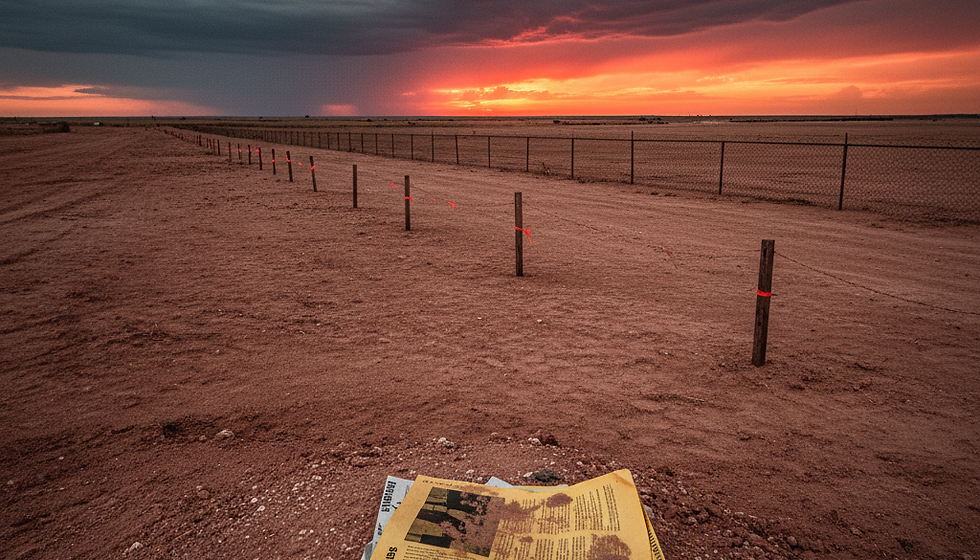
Fermi America had everything on paper. It had nothing that mattered.
In October, Fermi America IPO'd at a $19 billion valuation on the strength of a bold pitch: Project Matador, 11 gigawatts on 5,800 acres in the Texas Panhandle, branded the Trump Advanced Energy and Intelligence Campus, fronted by former DOE Secretary Rick Perry, powered by a mix of nuclear restarts, gas, and solar. Sovereign AI infrastructure at unprecedented scale. Land already controlled. A hyperscaler anchor signed to a $150 million Advance in Aid of Construction Agreement.
Seven months later: stock down 75%. CEO gone. Anchor tenant walked. Class action moving.
The hyperscaler was Amazon. When the exclusivity window expired in early December, AWS terminated the AICA two days later. Fermi disclosed it on December 12. The stock dropped 34% in a single session. A class action filed in January alleges Fermi overstated tenant demand and concealed how dependent the entire project was on that single commitment. Short reports from Cleanview and Fuzzy Panda followed with their own allegations of misrepresentation. CEO Toby Neugebauer resigned April 17. The 1.1 GW year-end 2026 capacity target has since been walked back.
This is not a story about a bad project. It's a story about a category error.
What Fermi Had
Let's be precise about what was real.
The land was real — 5,800 acres in the Texas Panhandle, controlled. The political alignment was real — Rick Perry as the face of the project, Trump branding baked into the campus name. The federal nuclear license pathway was real. The IPO proceeds were real. The hyperscaler was at the table — Amazon had signed a $150 million AICA, which is a meaningful instrument.
On a pitch deck, this is a full house. Land. Power story. Political cover. Federal pathway. Institutional capital. A hyperscaler's signature.
What it didn't have was a contracted tenant paying rent.
The AICA is a construction commitment mechanism, not a lease. It funds early site work in exchange for preferential access and exclusivity. When the exclusivity window expired and the tenant walked, the $150 million evaporated and there was nothing underneath it. No revenue. No signed offtake. No paying customer.
The entire $19 billion valuation was built on the assumption that Amazon would convert.
They didn't.
What's Actually Getting Built
While Fermi was preparing a press release, other operators were shipping product.
Crusoe is delivering modular GPU clusters in 90 days. Not announced — shipped. The cycle from contract to revenue-generating infrastructure is measured in weeks, not years.
Bell signed CoreWeave and Cerebras before it announced its Saskatchewan campus. When they went public with the project, paying tenants were already in the building. The announcement was confirmation, not aspiration.
Nscale acquired Monarch with Microsoft already locked in for 1.35 gigawatts. The acquisition happened because the offtake was real. The capital followed the contract.
Google paid $4.75 billion to take Intersect Power outright. That is not a speculative investment in potential. That is a utility-scale acquisition of contracted renewable energy capacity. Google bought the offtake book.
Every one of those transactions had a contracted customer at announcement. Not a letter of intent. Not an exclusivity window. A signed agreement with economic teeth — where walking away has a cost.
Fermi had a press release with Rick Perry's name on it.
The Bifurcation
The capital cycle in AI infrastructure is splitting into two distinct tracks, and the gap is widening fast.
Track one is the offtake-backed operator. They price like utilities — stable, predictable, yield-oriented. They move like manufacturers — procurement locked, delivery scheduled, revenue recognized on a timeline. CoreWeave, Crusoe, Nscale, the hyperscalers doing direct acquisition. These deals trade at infrastructure multiples because they are infrastructure. Contracted cash flows. Known counterparties. Real assets with real tenants.
Track two is the announcement-stage project. Political branding. TAM math. A compelling narrative about sovereign AI, national security, or energy independence. A land position. A power story. A letter of intent from someone who matters. A valuation that assumes conversion.
Track two just found out what happens when retail euphoria meets a tenant cancellation clause.
The AICA structure that Fermi used — construction commitment in exchange for exclusivity — is not inherently flawed. It's a legitimate project finance instrument. But it is explicitly contingent. The tenant has an out. And when the exclusivity window expired, Amazon used it.
The problem wasn't the instrument. The problem was treating a contingent commitment as if it were contracted revenue, and pricing a $19 billion valuation on top of it.
The Diligence Question Has Changed
If you're raising into this market right now, or allocating into it, the framing of the diligence conversation has shifted permanently.
It used to be: What's your power story? And that was a reasonable question, because power was the binding constraint. Site control, grid interconnect queue position, utility relationship, backup generation — these were the differentiators.
Power is still necessary. But it's no longer sufficient.
The new diligence question is: Show me the offtake.
Not letters of intent — those are free to sign and free to walk away from. Not exclusivity windows — those expire. Not advance commitments contingent on conversion — those evaporate when the counterparty decides the economics no longer work.
Contracted offtake. Signed lease. Paying tenant. A customer who has made an economic commitment with a real cost to exit.
Everything else is a pitch.
What This Means for the Infrastructure Build
The demand for compute is not going away. The hyperscalers are not pulling back — they're pulling forward. Microsoft, Google, Amazon, and Meta have committed over $300 billion in AI infrastructure capital for 2025 and 2026 combined. The buildout is accelerating.
But the hyperscalers are also getting more sophisticated about how they deploy that capital. They've watched Fermi. They've watched Prince William. They understand that announcement-stage projects carry execution risk that contracted projects don't. They are increasingly choosing to either develop directly — acquiring capable operators outright, as Google did with Intersect — or to sign long-term agreements with operators who have already proven they can build.
This is good news for the operators who can build. It's bad news for the ones who can pitch.
The window for announcement-stage multiples is closing. The operators who emerge from this cycle as durable infrastructure companies will be the ones who had paying tenants before they had a press conference.
Fermi had a press conference first. The market is now correcting for that.
The Lesson
Fermi America is not a cautionary tale about AI infrastructure being overbuilt or hyperscaler demand being oversold. The underlying demand is real. The need for the capacity Fermi was trying to build is genuine.
It's a cautionary tale about the difference between narrative and contract.
Rick Perry is a compelling face. The Trump Advanced Energy and Intelligence Campus is a compelling brand. 11 gigawatts in the Texas Panhandle is a compelling story. None of it substituted for a signed lease with a paying tenant.
In the next wave of AI infrastructure investment, the operators who win will be the ones who have already converted the narrative into contract before they raise the capital. The ones who show up to the raise with an offtake book, not a TAM slide.
The diligence question has changed.
Show me the offtake.
Letters of intent don't count.


Comments