
Quantum Is the Headline. Materials Are the Infrastructure.

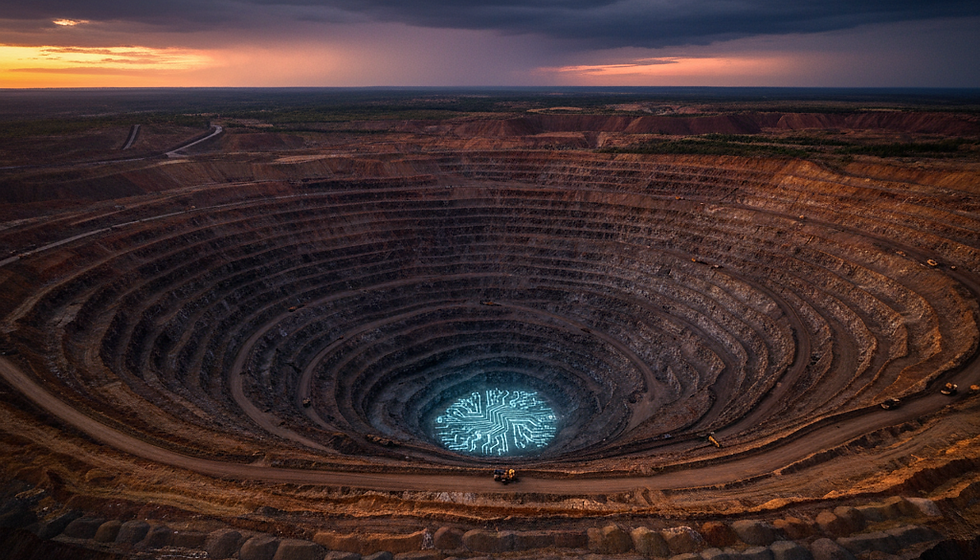

The market will naturally treat the White House's latest quantum initiative as a technology story. That's understandable. Quantum computing, post-quantum cryptography, quantum sensing, and secure quantum networks sound like they belong in the world of software, semiconductors, cybersecurity firms, national laboratories, and defense contractors. And they do. But that's only the visible layer.
The more important question for investors is this: What sits underneath it?
Every major technology revolution eventually becomes an infrastructure story. The internet wasn't just a software story. It became a story about fiber, data centers, semiconductors, and telecommunications infrastructure. Artificial intelligence isn't just a software story — it's rapidly becoming a story about GPUs, electricity, cooling systems, copper, uranium, and grid capacity. Electrification isn't simply about electric vehicles. It's a story about lithium, nickel, graphite, rare earths, transmission lines, and energy security. Quantum will be no different.
The first wave of capital will flow toward the obvious beneficiaries: quantum hardware developers, cybersecurity companies, cloud providers, cryptography specialists, defense contractors, and advanced research institutions. The second wave will move lower in the stack. Toward energy. Toward manufacturing. Toward strategic materials. Toward the physical infrastructure required to build, power, secure, and scale the next generation of technology. That's where this story becomes much bigger than quantum computing.
The Quantum Race Is Really a Sovereignty Race
The United States isn't accelerating quantum because it wants a faster computer. It's accelerating quantum because quantum technologies touch nearly every pillar of modern national power: defense, intelligence, communications, encryption, navigation, energy systems, materials science, and economic competitiveness.
Quantum isn't a standalone initiative. It's part of a much larger strategic realignment already underway. The same governments investing heavily in quantum are simultaneously investing in artificial intelligence, semiconductors, nuclear energy, domestic manufacturing, defense modernization, grid security, and critical minerals. These aren't separate policy objectives. They're different expressions of the same realization: advanced economies cannot afford to depend on fragile or adversarial supply chains for the technologies that define their future.
Quantum simply brings that reality into sharper focus. Because while quantum may operate in the digital realm, it ultimately depends on physical systems, physical infrastructure, and physical resources.
The Digital Economy Has a Materials Problem
One of the biggest misconceptions of the modern technology economy is that digital infrastructure is somehow weightless. It isn't.
AI requires enormous amounts of power. Power requires uranium, copper, steel, transformers, storage systems, and transmission infrastructure. Semiconductors require high-purity materials, specialty chemicals, advanced manufacturing systems, secure logistics, and reliable energy. Defense systems depend on titanium, rare earth magnets, specialty alloys, vanadium, and resilient domestic supply chains.
Quantum technologies will add another layer of demand — through advanced photonics, cryogenic systems, precision manufacturing, specialized magnets, shielding technologies, secure energy systems, and highly engineered materials. The point isn't that one mineral suddenly becomes "the quantum mineral." That's far too simplistic. The point is that quantum reinforces a trend already visible across AI, defense, energy security, semiconductors, and electrification: control over strategic materials matters again. For decades, markets rewarded asset-light business models. The next cycle may reward something different — ownership of resources, control of supply chains, access to trusted jurisdictions, and the ability to provide the raw inputs that advanced technologies require.
Why Critical Minerals Return to Center Stage
Rare earth elements are an obvious part of this conversation because of their role in advanced electronics, defense systems, clean energy technologies, and high-performance magnets. But the broader critical minerals ecosystem matters just as much.
Titanium remains essential to aerospace, defense, and advanced industrial applications. Vanadium is increasingly relevant in energy storage and industrial-strength materials. Uranium is becoming central to the conversation around reliable baseload power as AI and advanced computing drive unprecedented energy demand. Lithium remains foundational to battery storage and electrification. High-purity iron ore is increasingly tied to industrial resilience, advanced manufacturing, and lower-emission steel production.
These materials aren't side stories to the technology economy. They are part of the foundation. That's why every major policy push into advanced technology should also force investors to examine the upstream supply chain that makes those technologies possible. The market may initially price quantum as a software event. Strategically, it's also a materials event, an energy event, and a supply-chain event.
The North American Advantage
One of the most important phrases of the next technology cycle may not be "quantum advantage." It may be trusted supply.
The United States and its allies are no longer focused solely on inventing breakthrough technologies. They're focused on ensuring those technologies can be manufactured, powered, secured, and scaled within trusted supply chains. That naturally shifts attention toward North American resource development.
Canada occupies a particularly important position. It offers geological scale, established mining jurisdictions, proximity to U.S. markets, world-class mineral potential, and increasing strategic relevance across defense, energy, and advanced technology supply chains. Quebec and Labrador stand out specifically. Quebec brings hydroelectric power, infrastructure, mining expertise, and exposure to key strategic minerals. Labrador offers scale, exploration upside, uranium potential, iron ore history, and significant titanium-vanadium-iron systems that align with long-term industrial demand.
For investors seeking exposure to the next generation of strategic resource development, these jurisdictions deserve a closer look.
Looking Beneath the Theme
This is where critical minerals developers and explorers become increasingly interesting — not because they're "quantum stocks," but because they operate beneath the same structural demand curve.

One example is Saga Metals Corp., whose portfolio spans multiple strategic mineral categories across Labrador and Quebec. Its projects provide exposure to titanium, vanadium, uranium, lithium, high-purity iron ore, and rare earth elements — materials that increasingly intersect with defense modernization, energy security, electrification, and advanced technology supply chains.
The relevance isn't promotional. It's structural.
If AI, quantum, defense modernization, nuclear power, semiconductor resilience, and electrification are all moving in the same direction, then the upstream materials layer becomes increasingly difficult to ignore. Companies positioned within that layer deserve attention — not because they're directly tied to any single technology trend, but because they're tied to the foundation supporting all of them.
The Market Always Sees the Application Before the Input
We've seen this movie before. With electric vehicles, investors first focused on automakers. Then batteries. Then lithium, nickel, graphite, copper, permitting, refining, and processing capacity.
With AI, investors first focused on software models. Then GPUs. Then data centers, power generation, cooling infrastructure, uranium, natural gas, and grid capacity.
Quantum will likely follow a similar path. Investors will initially focus on hardware, algorithms, encryption, and cybersecurity. Eventually, the market will begin asking a more durable question: What physical infrastructure is required to support all of this?
That's where critical minerals become relevant — not as a marketing slogan, but as a potential bottleneck.
The Real Takeaway
Quantum may dominate the headlines. But the deeper story is that the next technological era will require a far stronger industrial foundation than the last one. The countries that lead won't simply be the ones with the best scientists, the most powerful algorithms, or the strongest cybersecurity standards. They'll be the countries with the energy, manufacturing capacity, mineral resources, and trusted supply chains necessary to turn breakthrough science into real-world capability.
That's why critical minerals belong in the quantum conversation — not because quantum changes the laws of resource demand, but because it reinforces them.
The quantum era may be measured in qubits. But it will still be built with materials.
Rich Washburn is a technologist and strategist working at the intersection of AI, infrastructure, and capital. He is Managing Partner and Chief AI Officer at Eliakim Capital, and CIO of Data Power Supply.



Comments