
Love, Chips & Espionage


Why Chinese intelligence would want access to the man at the center of the AI chip trade.
Nvidia has opened an independent investigation into reports that Chinese intelligence targeted its CEO, Jensen Huang. At the center of the story is Alice Huang, a former executive at Megaspeed, a Singapore-based data center company that buys Nvidia hardware. The New York Times reported that U.S. intelligence believes China's Ministry of State Security recruited her to gather information about American AI chips and potentially influence Nvidia to push for greater Chinese access to them. nvidianews.nvidia.com
That puts a chip supplier at the center of a counterintelligence story. Nvidia makes the processors companies use to train and run advanced AI models. Washington restricts exports of some of those chips because it wants to limit China's access to that capability. Jensen Huang sits close to both sides of that decision. He knows what customers are trying to buy, and he has lobbied Washington on what his company should be allowed to sell. apnews.com
Three House committee chairs have asked Huang to brief them behind closed doors about his interactions with Alice and Nvidia's safeguards against foreign espionage. Nvidia's board says it currently has no reason to believe company secrets or national security were compromised. Independent directors, assisted by outside counsel, will investigate. chinaselectcommittee.house.gov
How it became a story about an affair
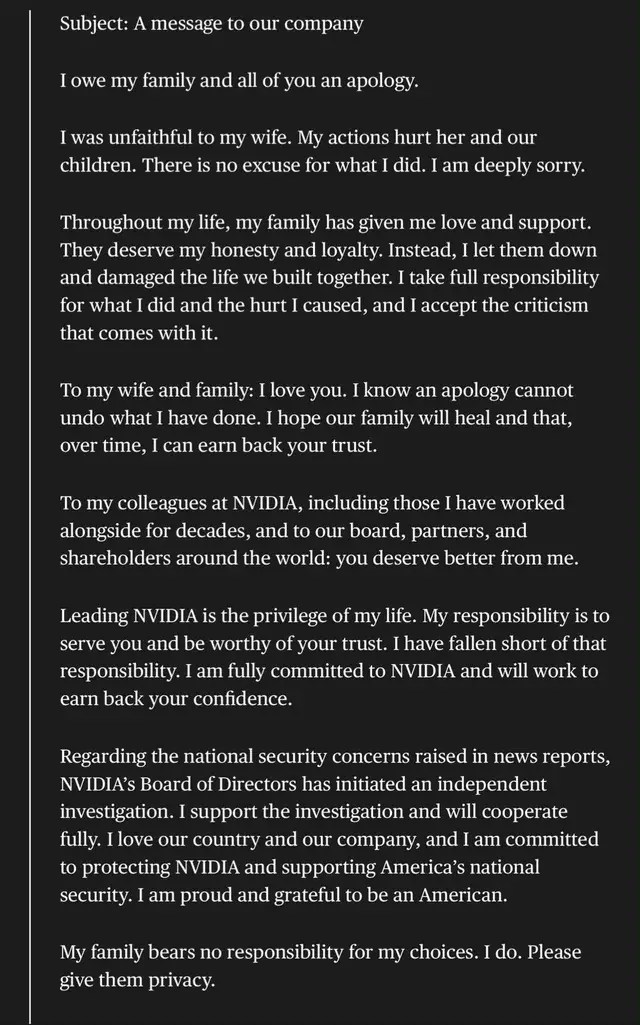
The Financial Times reported that a U.S. intelligence memo described a romantic relationship between Jensen and Alice Huang, who are unrelated. Then, on November 8, Nvidia published a message Jensen sent to employees acknowledging that he had been unfaithful to his wife. His public message didn't name Alice. The Times reported that he separately told Nvidia's board he had been intimate with her. www.ft.com
Yes, the Fang Fang reference practically makes itself.
But consider what an intelligence service might want from access to Jensen Huang. Which companies are buying enough hardware to make a serious move? Where are they building? How long will it take them to get the chips? What does Nvidia think Washington might allow it to sell six months from now?

A delivery schedule can tell you when a competitor might have enough computing power to train its next model. Advance knowledge of an export decision could change where you put your next order. The reporting leaves open what Alice Huang obtained from Jensen, if anything. You can still see why someone would want to be close enough to hear those conversations. finance.yahoo.com
Follow the computing power
Megaspeed is where this gets concrete. The Times reported that a Malaysian sister company bought at least $4.8 billion in advanced AI equipment containing Nvidia technology between June 2024 and February 2026. Megaspeed supplied computing capacity to Alibaba and other Chinese customers from outside China. U.S. officials have also investigated possible physical diversion of hardware, and Nvidia says its own review found no evidence of that. gvwire.com
Picture a server in Malaysia running a workload for a customer in China. The chips stay in the rack. The customer still gets the computing power. You could account for every serial number and still have to ask who's running jobs on the machines.
Then there's the paperwork for chips Washington has actually cleared. In separate reporting, the Times visited the listed offices of New Matrix and Maginfra, two Chinese companies approved to handle Nvidia H200 chips as server assemblers. The premises appeared empty, and reporters identified ties to restricted companies. That leaves a fairly basic question for the people issuing those approvals. Who's actually going to assemble and operate the servers? businesstimes.com.sg
The AI race has a loading dock
When we were talking about OpenAI's boardroom drama and the people around Anthropic's founder, we were asking who gets a say in what happens inside the companies building the models. Nvidia takes us one step upstream. Before a lab can decide what to build or when to release it, somebody has to get the hardware into a rack and turn it on. As the OpenAI Turns · Who—or What—Is Really in Charge at Anthropic?
That's the part of this story that sticks with me. Where a country points its intelligence services tells you something about what it thinks is valuable. If the reporting holds up, Beijing saw enough value in access to the world's leading AI chip supplier to make its CEO an intelligence target. While we're watching model demos, somebody else is watching purchase orders, delivery dates, and export licenses.
We talk about AI as though it lives in the cloud. The cloud, it turns out, has a loading dock.
Rich Washburn is a technologist, strategist, and Founder & Chief AI Architect of ARIA AI Labs, working at the intersection of AI, infrastructure, communications, and capital. He also serves as Managing Partner and Chief AI Officer at Eliakim Capital.


Comments