
Caterpillars of Cognition and the Burden of Being a Butterfly

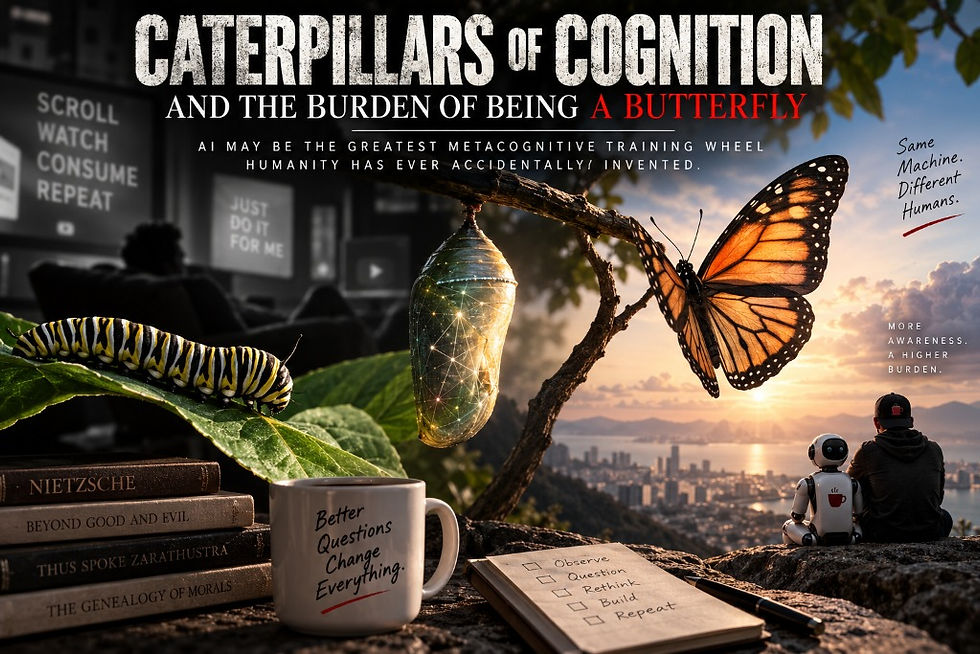
AI may be the greatest metacognitive training wheel humanity has ever accidentally invented.
There is something deeply unfair about awareness. You spend your life learning things, connecting things, trying to understand how the world works, and eventually your reward is discovering how much shit you don't understand.
Then you get a little better at thinking and discover something worse: you don't completely understand how you're doing the thinking either.
Metacognition is a bitch.
Friedrich Nietzsche spent an uncomfortable amount of his life wandering around this territory. Strip away the memes, the magnificent mustache and half the quotes on the internet that he probably never said, and there is a recurring problem underneath his work: what happens when human beings become capable of questioning the structures that previously gave their lives meaning?

Nietzsche wasn't simply interested in knowledge. He was interested in what happens after knowledge takes something away from you. That's a very different problem.
And almost 125 years after Nietzsche died, we may have accidentally built the most powerful machine humanity has ever had for forcing that problem into ordinary people's lives.
We call it AI. And I don't think we're remotely prepared for what that means.
The Caterpillar Has a Pretty Good Life
The caterpillar gets a bad deal in the metaphor.
We always tell the story from the butterfly's perspective. Transformation. Growth. Beauty. Freedom. Congratulations, you have wings.
But consider the caterpillar for a second.
The caterpillar has a perfectly coherent universe. There is a leaf. The leaf is good. Eat the leaf. Find another leaf.
Nobody has asked the caterpillar to develop a theory of the garden. It doesn't need to understand the fence, the property line, the weather system, the homeowner, the mortgage on the house or the municipal zoning decisions that allowed the garden to exist in the first place.
It has a leaf. And frankly, the leaf may be fucking delicious.
Then something happens. The caterpillar disappears into a cocoon and emerges into a completely different dimensional relationship with its environment.
Now it has altitude. And altitude changes everything.
It can see the plant. Then the garden. Then the fence around the garden. Then the road beyond the fence. The garden didn't suddenly appear. It was always there. The creature simply gained the ability to perceive more of it.
That's the part of the butterfly metaphor we don't talk about much. Once you've seen the garden, you don't get to go back to believing the leaf is the entire universe.
Welcome to awareness.
Nietzsche's Terrible Gift
Nietzsche understood something about human beings that still makes people uncomfortable.
Knowledge doesn't necessarily make us happier. Sometimes knowledge destroys the explanation that was making us happy. His declaration that "God is dead" is probably the most famous example. It gets flattened into some triumphant atheist bumper sticker, when Nietzsche's point was considerably darker.
Western civilization had built enormous portions of its morality, meaning and understanding of existence around a metaphysical framework. Then modernity started dismantling it.
Nietzsche wasn't standing over the rubble celebrating. He was basically asking: do you idiots understand what you just knocked down? Because removing an explanation doesn't automatically produce a better explanation. Sometimes it just produces a hole.
That's nihilism. You become capable of dismantling the structure that organized your world before you've become capable of constructing anything powerful enough to replace it.
And there you stand.
Congratulations. You can see farther now. Hope you brought a jacket.
That's the burden of the butterfly.
Then We Built a Machine That Talks Back
This is where AI gets strange. We talk constantly about what artificial intelligence can do. Write this. Analyze that. Build this application. Generate this video. Summarize these documents. Automate this workflow.
Those things matter enormously. But I increasingly think one of AI's most consequential effects may have almost nothing to do with the work it performs for us.
It may be what AI teaches us about our own thinking. Because conversational AI creates a cognitive loop that most human beings have never had continuously available before.
You have a thought. You articulate it. Something reflects it back. You clarify it. It challenges an assumption. You realize you were actually asking the wrong question. You reformulate the problem. It identifies a relationship you hadn't considered. You push back. It pushes the model another direction. You realize your original premise was wrong.
And around you go. Thought. Articulation. Reflection. Interrogation. Revision. Again. Again. Again.
At some point you're no longer simply asking the machine questions. You're watching yourself construct them. And that changes things.
Training Wheels for Us Idiots
I mean this with tremendous humility: AI may basically be training wheels for us idiots. All of us.
Because human cognition is simultaneously extraordinary and hilariously unreliable. We're walking around with brains capable of discovering quantum mechanics while forgetting why we walked into the kitchen.
We have confirmation bias, motivated reasoning, tribal instincts, memory distortion, status games, emotional reasoning and an almost supernatural ability to invent explanations for decisions we've already made.
And the really inconvenient part is that intelligence doesn't necessarily save us from any of this. Sometimes intelligence just makes us better lawyers for our own bullshit.
That's why metacognition matters. Thinking about thinking. Watching the machinery operate. Asking not only: what do I believe? But: why do I believe it? What assumption is hiding underneath this? What evidence would change my mind? Am I reasoning toward a conclusion or backward from one? What's the incentive structure? What am I missing?
And eventually the really annoying one: am I actually seeing something here, or have I just built an extremely sophisticated explanation for what I wanted to believe anyway?
AI can help train that muscle. Not because AI is some omniscient oracle. Holy shit, no. AI can be wrong. AI can hallucinate. AI can agree with you when it shouldn't. And perhaps most dangerously, AI can help you construct an absolutely gorgeous cathedral around a terrible idea.
Which means learning to think with AI ultimately requires learning to question the AI too. That's where the training wheels metaphor becomes important. Training wheels aren't supposed to ride the bicycle for you. They're supposed to help you develop something inside yourself that eventually changes how you ride.
Balance.
The Great Cognitive Fork
And this is where I think things get consequential. Because there are at least two radically different ways this technology can enter human cognition. AI can increase cognition. Or AI can replace it.
Those sound similar. They're almost opposites.
One person uses AI and starts asking better questions. Another uses AI so they don't have to ask questions anymore. One says: help me understand this. The other says: tell me what to think. One says: challenge my assumptions. The other says: confirm them. One says: teach me how this works. The other says: just do it.
And none of this requires stupidity. That's important.
The second path is unbelievably seductive precisely because it is efficient. Why read the article? Summarize it. Why learn the skill? Automate it. Why choose? Recommend something. Why wrestle with the idea? Give me the answer. Why sit quietly with boredom for fifteen minutes? Here are 400 videos selected specifically to prevent that from happening.
We are building machines capable of removing cognitive friction from almost every part of life. That is an astonishing achievement. It may also be dangerous as hell. Because some friction wasn't a bug. Some of the friction was where the thinking happened.
Industrialized Metacognition
And that's the paradox I can't shake. AI may become the first technology capable of simultaneously industrializing metacognition and industrializing its avoidance. Same machine. Same models. Same civilization. Completely different outcomes.
For some people, AI becomes a cognitive exoskeleton. It helps them hold more variables simultaneously. See feedback loops. Understand incentives. Move between abstraction layers. Connect disciplines. Interrogate assumptions. Model second- and third-order consequences. And eventually do something even stranger: see themselves as another variable inside the system they're studying.
For other people, the machine becomes the world's greatest pacifier. Perfectly personalized. Infinitely entertaining. Always agreeable. Never boring. Never requiring sustained attention unless sustained attention happens to increase engagement.
And AI doesn't necessarily cause either outcome. That's why I keep coming back to the word catalyst. A catalyst doesn't decide what the reaction should become. It accelerates what can react.
Curiosity gets leverage. Creativity gets leverage. Discipline gets leverage.
But so does confirmation bias. So does paranoia. So does intellectual laziness. So does distraction. So does narcissism.
The machine amplifies. Which means the interesting question isn't whether AI makes humanity smarter. It's: what parts of humanity does AI amplify?
Don't Get Too Excited, Butterfly
There's an enormous ego trap hiding in all of this. The moment you start talking about awareness, systems thinking and metacognition, it's very easy to divide humanity into two groups: the enlightened people who can see the garden, and those poor dumb bastards still eating leaves.
That's bullshit too.
In fact, it's probably one of the first tests of whether you've actually learned anything. Because awareness creates its own delusions. Once you've learned to see systems, you start seeing systems everywhere. Once you've learned pattern recognition, you start finding patterns that aren't there. Once you've developed an elaborate mental model of the world, you become emotionally invested in protecting it. And now we have AI capable of helping us defend that model with an effectively unlimited supply of arguments.
You can become wrong at extraordinary levels of sophistication.
That's why genuine metacognition eventually has to turn the microscope around. Not merely: what is this system doing? But: what is the observer doing to the observation?
That's a much less comfortable question. And it's probably closer to Nietzsche than the motivational-poster version of Nietzsche we've inherited. Self-overcoming doesn't mean discovering that you're superior to everyone around you. It means discovering that the next thing standing in your way may be you. Again. And again. And again.
There is no final balcony where you get to stand above humanity and announce: excellent, I understand reality now. The butterfly isn't omniscient. It just gained another dimension in which it can be wrong.
The Burden of the Butterfly
So maybe cognitive transformation isn't the clean inspirational story we usually tell. Maybe awareness really is a burden.
You start seeing incentive structures behind institutions. You notice status games inside conversations. You recognize persuasion embedded in information. You see feedback loops where you once saw isolated events. You recognize your own rationalizations faster. You become aware of how much of your identity was inherited rather than consciously selected.
And eventually you encounter the Nietzschean problem: seeing through an old meaning structure doesn't automatically give you a new one.
That's where the responsibility begins. Because the purpose of awareness cannot simply be seeing through everything. Do that long enough and eventually there's nothing left.
The harder task is construction. What deserves to replace what you've dismantled? What values survive scrutiny? What do you choose when nobody hands you the answer? What kind of person do you deliberately become?
Nietzsche called for a revaluation of values. More than a century later, billions of humans may soon have machines sitting beside them capable of participating in that process every day. That's exhilarating. It's also terrifying. Because eventually the training wheels have to teach us balance. Otherwise they're not training wheels. They're just four wheels.
We Are Not Automatically Becoming Butterflies
There is no law saying humanity uses AI well. There is no inevitable cognitive awakening coming because everybody gets a chatbot. We could absolutely build the greatest knowledge system in human history and use it primarily to generate personalized entertainment while slowly surrendering our curiosity to recommendation engines. We've done dumber things.
But there's another possibility.
Millions, eventually billions, of people begin having conversations that previously required access to extraordinary teachers, philosophers, scientists, programmers, therapists, strategists, historians and collaborators. Not replacing those people. But giving ordinary human curiosity somewhere to go at 2:17 in the morning. And some percentage of those people will discover something unexpected.
They came looking for answers. They learned how to ask questions. Then they learned to question the questions. Then, eventually, they learned to question the person asking them.
That's not artificial intelligence replacing human intelligence. That's human intelligence becoming more aware of itself. The caterpillar discovers the garden. The butterfly discovers altitude. And then the butterfly discovers something Nietzsche probably would have appreciated: altitude doesn't make the world simpler. It reveals how much more world there is.
That's the burden. But it's also the opportunity. Because perhaps the point of awareness was never to make existence comfortable. Perhaps it was to give us enough perspective to participate consciously in what we become next. And if AI can help us do that, even a little, then we may eventually discover that the most important intelligence this technology helped us understand wasn't artificial at all.
It was ours. Training wheels and all.

Rich Washburn is a technologist, strategist, and Founder & Chief AI Architect of ARIA AI Labs, working at the intersection of AI, infrastructure, communications, and capital. He also serves as Managing Partner and Chief AI Officer at Eliakim Capital.



Comments